• Skip to primary navigation
  • Skip to main content
  • Skip to footer

Keppie Careers

Social media speaker, social media consultant, job search coach

  • About
    • Expert Job Search and Social Media Consultant / Speaker
  • Services
    • For Job Seekers
    • For Entrepreneurs
    • Social Media Coaching and Consulting
    • Speaking/Keynotes
  • Resources
    • Sample Resumes
    • Quoted In
  • Books
  • Blog
  • Contact

A Mother’s Day tribute

May 13, 2012 By Miriam Salpeter

In honor of Mother’s Day,
I dedicate this post in
memory of my mom.

Few people doubt the important role mothers serve. A book by Stephan Poulter, The Mother Factor: How Your Mother’s Emotional Legacy Impacts Your Life, suggests that “There may be a direct link between our career success and our mothers.” (Hat tip, Anita Bruzzese.)

Alexandra Levit blogged about Anita’s post about our mothers’ influence on career success:

The book’s thesis is that, whether we acknowledge it or not, our mothers leave an indelible impression on the people we become. Our ability to function in personal and professional relationships is based on our mothers’ “styles.” Poulter defines the five major styles of mothering as:

* The Perfectionist Mother: whose family must look perfect in every way.
* The Unpredictable Mother: whose ups and downs can create lifelong anxiety and depression in her son or daughter.
* The “Me First” Mother: whose children come second or last.
* The “Best Friend” Mother: who’s now in vogue but can wreak havoc.
* The Complete Mother: who provides guidance and shows compassion to her child.

For example, if your mother was a perfectionist, then you might have difficulty taking feedback at work. “Ninety five percent of the time it’s your emotional history spilling into the present,” Poulter says.

If this research is correct, I am even more lucky than I thought to have had such an encouraging, supportive, caring and giving mom. My mom was exceptional and unique in many ways. She had high standards for herself and others. She taught me to believe in myself, to set goals and work hard to achieve them. She was instrumental in helping me develop my soft skills, including writing, communication and common sense.

My mom demonstrated a strong work ethic and instilled that ethic, along with a can-do attitude that supports me to this day. I am so appreciative to have had that foundation upon which to build my life and career. I am so grateful…I continue to realize how much my mom taught me the longer she is gone. I think about her on Mother’s Day and every day.

photo by foxrosser
Filed Under: Career Books Tagged With: best career speaker, Career Advice, how to find a job, keppie careers, Miriam Salpeter, Mother's Day

Networking tips to help you land your first job

May 2, 2012 By Miriam Salpeter

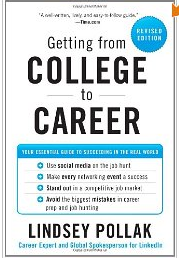
Are you planning a transition “from college to career?” You won’t want to miss out on advice from Lindsey Pollak, a recognized expert on next-generation career trends. She recently released a new edition of her terrific book, Getting from College to Career.  In this second of a two-part Q & A with Lindsey, she outlines some best practices for networking, following up, and transitioning to your first job. (Don’t miss part I of our interview.)

In addition to LinkedIn, what online tools do you think are most helpful for new grads to improve their networking potential?

Lindsey: I think people misjudge Twitter as a career and networking tool. It is a phenomenal research tool for following companies, people and industries that interest you and learning what they want you to know about them. We never had such direct access to such information before. Twitter gives you a million topics to learn and think about – which can then be used in a variety of networking situations from informational interviews to career fairs to informal conversations.

What are your best tips for following up after an informational meeting? How about how to follow up after an interview?

Lindsey: I recommend that people start the follow-up process during the actual meeting or interview by asking the other person how he or she likes to receive follow-up. For instance, at the end of a great chat at a networking event, you can say to the other person, “I really enjoyed speaking with you. What’s the best way to keep in touch?” Then you can find out if the person prefers email, phone or perhaps connecting on LinkedIn or another social network.

If you haven’t had this conversation, follow up is still extremely important. I suggest following up with a concise email that has a really descriptive subject line, such as “Nice to meet you at Thursday’s NYC Networking Night” or “Thank you for the interview – online marketing assistant position.” This helps your email stand out from all of the bland follow-up emails that say “thanks” or “interview.” Next, thank the person for his or her time and mention something from the meeting that stood out to you or a topic that you could tell the interviewer was particularly interested in. Finally, end with some sort of added value – another thought you had from the meeting or an idea that it sparked. Show that you are someone who always gives a little bit extra.

In your book, you write about being persistent – without being a pest. Can you share a tip or two for how a job seeker should know how to identify that fine line between following up enough and too much?

Lindsey: There really is a fine line. The right kind of persistence is always polite, positive and appropriately timed. You should send a thank you email within 12 to 24 hours of a formal job interview using the tips in the previous answer. Then mark in your calendar to wait one full week before attempting any other follow up. I know a week feels like a long time when you want a job, but it’s a short time to the person who interviewed you.

If you don’t hear back after a full week (or even 10 days), it’s okay to send a second email. Now here’s the fine line: it’s pestering to write, “I haven’t heard back from you and I wanted to know if you’re still interested in hiring me.” It’s polite and appropriate to say, “I wanted to thank you again for our interview last week. In the meantime, I’ve read more on [something you discussed] and [then say something you learned or an idea this research sparked]. Would you be able to let me know any next steps at this point?”

If you don’t hear back from the second email, it’s probably not a great sign. If you’d like to give it one more try, a third follow up action is the last I would take. You can try another polite email, leave a voice mail message after hours (with a similar, positive follow-up comment) or reach out to the person on LinkedIn or Twitter if you know he or she is active there.

In my opinion, three attempts is the maximum. You’ve given it your best shot and, unfortunately, not everyone is responsive. I believe employers should let you know if you are not getting a job you’ve interviewed for, but that doesn’t always happen. Hopefully you have a lot of irons in the fire and your persistence for other positions will pay off!

What do you think is the most difficult thing for new college grads to manage in their transition to a first job?

Lindsey: Communication skills are very different between college and the “real world” and that’s where I tend to see new grads make the most mistakes. In a professional environment, you have to remember that everything you write or say is contributing to your professional reputation.

This means that emails need to be written in a professional style and tone (limit text message speak, limit or eliminate emoticons, avoid using “Hey” as a greeting, etc.) and you have to carefully choose your communication methods. Texting and IM are generally not appropriate for the workplace (unless you’ve specifically discussed using these methods with your boss or your company has an internal IM system) and you need to learn to speak well in meetings and professional presentations.

Be sure to check out her book: Getting from College to Career.

This post originally appeared on Salary.com, where I am a contributing writer.

Filed Under: Career Advice, Career Books, Generational Search Tagged With: career expert, career speaker, how to get a job, how to network, keppie careers, Lindsey Pollak, Miriam Salpeter

Advice for first-time job seekers

April 2, 2012 By Miriam Salpeter

As graduation approaches, many young job seekers are wondering how they can land an opportunity in this very challenging job market. Lindsey Pollak, a recognized expert on next-generation career trends, recently released a new edition of her terrific book, Getting from College to Career. [Read more…] about Advice for first-time job seekers

Filed Under: Career Advice, Career Books Tagged With: Career Advice, career expert, career speaker, getting a job without experience, how to get a job, keppie careers, Lindsey Pollak, Miriam Salpeter, new job seeker advice

Important information about work-life fit/flexibility

June 16, 2011 By Miriam Salpeter

One issue for many job seekers is landing an opportunity offering “flexibility,” “balance,” or, what consultant,  Cali Williams Yost, CEO and Founder of Flex Strategy Group and author of Work+Life: Finding the Fit That’s Right for You, would call “work-life fit.”

Today, I’m happy to share research Cali sent me from from the 2011 Work+Life Fit™ Reality Check Survey. It illustrates that, “Work life flexibility is no longer a bright, shiny, novelty item that only a few people have.  In fact, most full-time employees have some form of work life flexibility and they are much less afraid to use it than they were five years ago.”


The following tips are directly from survey findings to help you get the most out of the work life flexibility that’s become a foundational part of the way we live and work:

Tip 1: Don’t let too much work and too little time keep you from work life flexibility, instead use that flexibility strategically to get your work done and have a life. When asked, respondents ranked “increased workload or no time for flexibility” as the top obstacle (29%) that kept them from using or improving their work life flexibility.  Looked at another way, flexibility could also be the key to managing that greater workload and having more time for the other parts of your life.  A periodic shift in hours, or working from home now and then could restore a sense of productivity and well-being.  Be creative.

Tip 2: Remember that work life flexibility comes in many forms.  It includes both day-to-day, informal ad hoc shifts in how, when and where you work, as well as formal plans that officially change your work+life fit. Even though 62% of respondents said they had some type of day-to-day, ad hoc flexibility, it’s easy to take it for granted as a given.  Use it thoughtfully and strategically to manage the way work fits into your life every day. If you are interested in more formal plan, learn ahead of time how to present a proposal that’s a win for you and the business.

Tip 3:  To make informal, day-to-day flexibility a success for you, your team and the business, make sure to communicate and coordinate with all of the key stakeholders, not just your supervisor. According to the survey, when respondents made occasional changes in how, when and where they work, they discussed those changes with:

  • 79% their supervisor
  • 63% their spouse, family or partner
  • 52% their colleagues
  • 45% those they supervise, and
  • 7% no one.

You don’t need to tell your colleagues and those you supervise why you are using flexibility, but let them know how the work will get done and how they can reach you if needed.

Tip 4: Challenge any lingering fears that may be keeping you from using or improving your work life flexibility. Make sure any fear or concern is based on fact, not invalid assumptions.  The good news is that individuals are much less likely to let fear or negative perceptions keep them from using or improving their flexibility than they were in 2006:

  • You might make less money:  21% in 2011 versus 45% in 2006
  • You might lose your job:  16% in 2011 versus 28% in 2006
  • Others will think you don’t work hard:  11% in 2011 versus 39% in 2006
  • You worry that your boss would  say “no”:  13% in 2011 versus 32% in 2006

However, obviously some fears and concerns linger.  Learn about the compensation policy related to flexibility where you aren’t working less, just differently.   Understand the employment climate in your organization.  Make sure you continue to work hard, communicate and coordinate well (see Tip 3) and learn how to present a flexibility plan that’s a win-win and hard to turn down.

Tip 5: Understand that work life flexibility is more than a perk, or benefit.  It’s a strategy that your employer can use to “retain talent, manage workload and grow.”  And without it, the business will suffer particularly in the areas of health/wellness, morale and productivity.  One of the surprising findings for the 2011 Work+Life Fit Reality Check is how many respondents either think work life flexibility is a “perk or benefit” (36%) or “don’t know” what it is (14%).  Just as work life flexibility can help you strategically manage your workload and resources, it can also benefit the business in other areas.  Specifically, a majority of respondents (66%) felt that without work life flexibility health (48%), morale (41%) and productivity (36%) would suffer.

For more details and to download the study, visit Work Life Fit Tips.

You may also want to read a study addressing the issue of inevitability of work-life flex, Findings from the Flexpaths – LinkedIn study.

photo by ellajphillips

Filed Under: Career Books, Drive Your Career Bus Tagged With: balance at work, Cali Williams Yost, career coach, career expert, how to find a job, keppie careers, Miriam Salpeter, work flexibility, work+life fit reality check survey

How to be “Great on the Job,” a review

May 23, 2011 By Miriam Salpeter

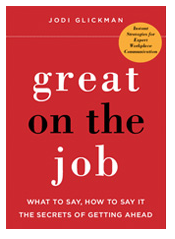
Communication — and communicating well, in business and in all circumstances — is key for career success. It’s not always easy to know what to say, and it certainly isn’t always obvious how to say it. Jodi Glickman’s new book, Great On the Job, comes to the rescue. Known as a strong, strategic communicator with many successful examples to back up her words, Jodi, who’s landed jobs due to her interviewing skills, even though she’s been told she was the “least qualified” of all the candidates, outlines how to communicate well for professional success.

Jodi teaches readers how to re-think the basics. (When’s the last time you re-evaluated how you introduce yourself on a phone call? Do you ask the person if it is a good time to talk?) to more advanced communication skills, including how to manage in a crisis, communicate about a missed deadline or how to recover when you aren’t prepared for a presentation).

She focuses on four concepts:

Generosity – thinking about the other person before you consider your own needs and focusing on how to make that person’s life better.

Initiative – being proactive without creating work for others, thus moving your career forward by “engaging in meaningful and productive work that contributes to the greater good” (p. xxiii).

Forward Momentum – creating, nurturing and sustaining personal relationships, even when you have no specific “reason” in mind, other than to just keep in touch.

Transparency – being honest when you mess something up and admitting when you don’t know something.

In easy-to-follow case studies, she describes scenarios and outlines exactly how to respond in each situation.

As a bonus, the book includes details about how to sell yourself. I loved the section, “Different Person, Different Pitch,” where Jodi outlines how important it is to identify which of your stories will resonate with your audience members. She explains, “Just as you probably have multiple online profiles — Facebook, Linkedin, Twitter — you should also understand that different situations warrant different pitches of stories.” She walks you through how to focus on determining what elements of your story to develop and use later.

To top it off, there’s a “cheat sheet” section at the end, outlining advice from each of the sections and reminding the reader of the salient points in each chapter. What a great resource for anyone reading the book and a way to be sure it’s easy to implement Jodi’s advice!

I highly recommend picking up a copy of Great on the Job to learn “what to say, how to say it — the secrets of getting ahead.”

Visit Jodi’s site to learn how to purchase a copy from your favorite bookseller.

Filed Under: Career Books, Communicating Tagged With: communicating at work, Great on the Job, how to communicate well, how to find a job, how to get a promotion, Jodi Glickman, keppie careers, Miriam Salpeter

  • « Go to Previous Page
  • Page 1
  • Interim pages omitted …
  • Page 4
  • Page 5
  • Page 6
  • Page 7
  • Page 8
  • Interim pages omitted …
  • Page 16
  • Go to Next Page »

Follow Us!

  • Facebook
  • Instagram
  • LinkedIn
  • Pinterest
  • Twitter

Be an Insider: Sign Up to Receive Special Offers & Free Gift


About Keppie Careers

Are you a job seeker or business owner? You’ve come to the right place!
Click here to find out more.

Contact Us

Have a question or comment?
Click here to Contact Us.
© Copyright 2024 Keppie Careers