• Skip to primary navigation
  • Skip to main content
  • Skip to footer

Keppie Careers

Social media speaker, social media consultant, job search coach

  • About
    • Expert Job Search and Social Media Consultant / Speaker
  • Services
    • For Job Seekers
    • For Entrepreneurs
    • Social Media Coaching and Consulting
    • Speaking/Keynotes
  • Resources
    • Sample Resumes
    • Quoted In
  • Books
  • Blog
  • Contact

Web design and resume tips

May 21, 2011 By Miriam Salpeter

This week, I noticed Chris Brogan posted a video highlighting tips from Derek Halpern of Social Triggers.

In the video, Derek was outlining things to think about regarding website design and how to pull together a site to encourage people to take the actions you want them to take. Watching it, I realized a lot of the advice Derek offered is similar to advice to I give to help people optimize resumes.

The first thing he said, “Just because you know what you’re about doesn’t mean others do,” got me taking notes for a resume post! It’s so true, and something a lot of people don’t think about when they write their own resumes. It could be very clear to you what you’d like to do next, but if your resume (or online materials) don’t make it obvious where you are headed, you will probably lose your audience. On a website, that means the reader will immediately click away. On a resume, it means you won’t get a chance to interview for the job.

Today, I reviewed a resume from someone I thought was interested in working in the medical field. (Based on something I had seen her post elsewhere.) However, the resume itself had nothing about the medical field on it at all. I’m now assuming I was wrong about what I previously saw, but someone in a position to hire someone in the medical field will simply put the resume aside, assuming there is no direct connection between the candidate and his or her hiring needs.

Another thing Derek points out in the video: “Welcome is not a good benefit – make a promise.” This, in relation to how to encourage people on your website to DO what you want them to do. Just “welcoming” them doesn’t cut it. Think about this regarding both cover letters and resumes — how are you showcasing something (a promise) to encourage readers to be interested in learning more about you? And no, just saying, “look at me” isn’t enough.

Which leads to Derek’s suggestion to use a headline at the top of a website! The best resumes today take advantage of headlines to reel readers in. The headline needs to be about your future, not your past. It’s about the job you want NEXT. Do you use headlines in your resume? They can be your targeted title, focus on your accomplishments, skills…The headline needs to be what will interest your reader. The headline is like a “promise” saying you are what the reader wants.

Derek kept talking about making that promise. He reminded viewers of an interesting point:  “Cluttered (web) pages used to convert better because people would be confused and click on ads.” I thought that was so interesting! Maybe that is why there are so many cluttered web pages out there – people are focusing on strategies that USED TO work. Same with resumes — so many resumes look dated and old fashioned. It’s time to think about what works today. Don’t get caught up in yesterday’s best practices.

Derek also gives advice regarding regarding font size, color, encouraging people to take action once they land on your website…While font sizes and use of color on resumes is a little different, the touch points between his web advice and resume advice are similar: you need to spell out your message clearly and make it easy to read and understand in order to convert readers to fans. Take a look at the video and be sure to visit Chris Brogan’s site for lots of useful and interesting information about social media and other topics.

photo by >^..^< maggz >^..^<

Filed Under: Career Advice, Resume Advice Tagged With: Chris Brogan, Derek Halpern, how to get a job, how to write a resume, job search coach, keppie careers, Miriam Salpeter, social media advice, website advice

How to stand out on your resume

May 15, 2011 By Miriam Salpeter

Almost every resume I see reads like a laundry list of “stuff” the person has done at work. The problem is that everyone applying for the job you seek probably has a similar list of “stuff.” What makes you stand out? Why are you special – why do YOU deserve to win an interview and the job?

It certainly isn’t because you were “Responsible for” something or that you were “Recruited to” do something. A prospective employer wants to know what you’ve accomplished. What impact have you had on past employers? What obstacles did you overcome to achieve a positive result?

The most important thing you can do is target your resume specifically for the job. Use the job description as your guide and provide proof in your application materials that you have the skills necessary to accomplish the position’s goals.

Quintessential Careers compiled a comprehensive list of accomplishments employers seek.

Describe how you:

  • Make money
  • Save money
  • Save time
  • Make work easier
  • Solve a specific problem
  • Help the company become more competitive
  • Build relationships
  • Expand the business
  • Attract new customers
  • Retain existing customers

I suggest you answer the following questions:

  • What problems did you solve?
  • How did you improve your organization?
  • What innovative ideas did you introduce (and what were the positive results)?
  • How did you make a difference?

When you re-focus your resume spotlight to shine on what you have to offer instead of just listing what you’ve done, you will be much more marketable.

photo by Samurai John

Filed Under: Resume Advice Tagged With: accomplishments employers want, career coach, career expert, how to get a job, how to write a resume, keppie careers, Miriam Salpeter, Resume Advice

Should you leave dates off your resume?

March 23, 2011 By Miriam Salpeter

Regular readers know I always tell my clients there is no ONE RIGHT way to conduct a job search. Best practices? Yes. Opinions on the best way to do things? Absolutely! The trick is to identify people who provide opinions based on actual information from people involved in hiring. Unfortunately, there are a lot of people advising job seekers based on nothing but their own experience, which may or may not translate effectively to others.

One slightly controversial piece of advice regarding resumes is about using dates. Typically, when I hear arguments about including dates or not on a resume, the focus is on graduation dates, but I’ve recently become aware that some people are advising job seekers to list some of their job experience without dates.

Graduation Dates on Resumes

Some people believe if they graduated from college too long ago, hiring managers will pass over their resume, assuming them to be too old, too inflexible or too expensive to hire (based on the number of years of experience).

Advice to remove graduation dates targets younger and younger people! I had one client tell me he’d been advised to take the years off of his schooling since it had been more than five years ago. That is an extreme piece of advice. Generally, anyone over 50 may be told to make themselves “look younger” by removing graduation dates.

Need help knowing what to say and how to say it in job search?
Check out my new book: 100 Conversations for Career Success

Should you leave graduation dates (years) off of your resume? I’m not a fan of this practice. Why? Because, if you leave off the date, you allow the reader to assume when you may have graduated. The hiring manager will naturally believe you are “more experienced” — perhaps even much more experienced (read: older) than you actually are! If your goal is to look younger, that’s what we on Twitter would label a major #FAIL.

Are there circumstances where leaving off graduation dates may make sense? Possibly. If you could have retired 10 years ago, you probably can’t hurt yourself leaving off your graduation date!

Dates for Experience

I’m working with a client now who has been advised to list certain jobs she held in the past without dates. Not all of her work experience, just a few older positions. At first, I thought she had misunderstood the previous career advisor’s instructions, but from talking to a few people, it appears as if this advice to omit dates on certain job experiences is typical.

My bias is to always include dates on experience; I thought it was crazy to advise a job seeker to leave dates off of certain work experience. (My preference would be to leave off the jobs altogether if they were not crucial to the candidate’s time line. For example, account for the last 10-15 years of experience and omit older jobs that don’t add anything to your candidacy.)

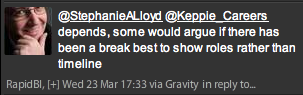
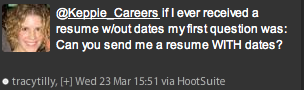
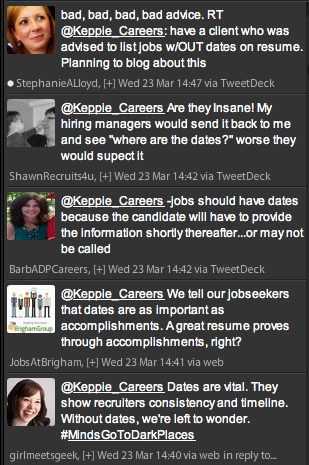
I’ve spent a lot of time with recruiters who influence some of my advice to job seekers. Granted, most jobs are not filled via recruiters, but I believe their take on resume norms is valuable, since they constantly evaluate candidates. I posed the question of dates on a resume to my Twitter community, saying, “#Recruiters -I have a client who’s been advised to list jobs withOUT dates on resume. Planning to blog about this. Love to quote you!”

These are the replies I received. Read them from the bottom up to follow the conversation.

While @RapidBi, an organizational change consultant, believed there could be a case for a resume without all of the dates, clearly the trend in this unscientific survey points toward including dates or risking attracting suspicion.

If someone is telling you to leave dates off of your resume, only do so after carefully considering the possible ramifications. Have I heard of people who removed certain dates (typically graduation dates) and still landed interviews? Yes, I have. Be sure to make your decision from an informed perspective. Ask you advisor or coach why he or she recommends one way or another; don’t be afraid to inquire why. Anyone who knows what they are doing will welcome the opportunity to explain.

— If you’re looking for a job and could use a boost, be sure to pre-order a copy of my book, Social Networking for Career Success AND consider getting your own, personal website – a social resume!

photo by Caro’s Lines

Filed Under: Resume Advice Tagged With: career coach, how to get a job, keppie careers, Miriam Salpeter, older job seekers, should you include dates on your resume, tricks for experienced workers

Why you need your own website – and how to get one!

February 20, 2011 By Miriam Salpeter

Do you believe you need an online presence to help you land a job — or to help you manage your career? I spent 45 minutes last week trying to convince a career-changing friend she needed HerName.com. She is finishing an advanced degree and will be looking for opportunities in a teaching specialty. She can’t understand why it is important to have an online presence, and she made some good points:

  • I’m going to get a job because my professor recommends me to a colleague; it doesn’t have anything to do with having a website.
  • I’m not comfortable having information about me online that just anyone can find.

I tried my go-to reasons to explain why her own site was a good idea:

  • Even if your professor recommends you for the job, it’s likely the hiring manager will also Google you. What will she find?
  • A personal site is a way to control how your name appears online.
  • Statistics show your online presence matters, and that employers are looking for personal and professional data about you.
  • In fact, while you may think you have “privacy” online, NOT putting up your own site only gives people an incentive to look deeper in the web for information about you. Take a look at these sites to learn what the “deep web” knows about you: pipl.com, Polymeta.com.
  • Managing a site is important for career insurance and professional development. Showcasing your expertise online (even if it is in a new field) helps demonstrate what you have to offer, even when you aren’t looking for a job. An online presence can grow and change along with your career and help attract people to learn more about you. This could result in opportunities to speak at conferences or events, or even invitations to apply for jobs down the road.

None of this persuaded her. Finally, I came up with one last point…Something I’ve written about, but hadn’t thought to bring up during our conversation:

  • Having a website suggests you have some technical savvy and understand how to use online tools to communicate. That, in and of itself, is an important skill many employers value. It’s known as “social proof.” You may say you know about technology on your resume, but actually using it to showcase your own information goes a long way to prove you have what employers want.

Finally! She replied…”I can see how that would be important.” Noting technology in the classroom is key, and knowing how to use it could be useful, she acknowledged the “social proof” argument was more persuasive than anything else I said.

Especially if you are transitioning to a new job or an experienced job seeker who needs to overcome age discrimination, having an up-to-date online presence and maybe even a viable blog helps show prospective employers you’re willing to learn and are perfectly capable of keeping up with technology.

Maybe you, like my friend, are skeptical. You can’t envision how and why having an online presence will help you get a job, manage your career or become known as an expert in your field. Since I spend so much of my time keeping up with job search strategies and researching tools job seekers and careerists need to use, it’s so clear to me that having YourName.com is crucial to your professional identity and to managing your career.

That’s why I created a product/service to help people (even the skeptical ones) secure and manage their own websites. I’m giving it away for a steal (a colleague told me I should be charging $1000+). Think about how your investment can help you move in the right direction for your career and visit my new site to learn how to get a social resume: http://www.getasocialresume.com/.

photo by nyuudo

Filed Under: Job Hunting Tools, Resume Advice, social media, Social Networking Tagged With: career coach, get a job, how to find a job, Miriam Salpeter, social resume, why you need an online presence

5 tips to write a winning resume

January 19, 2011 By Miriam Salpeter

With five candidates for every job, competition is fierce. Your online profile impacts your chances to win interviews, but your resume is still the most crucial element of your job search strategy.

Here are five tips to help you identify how to appeal to your targeted employers:

1.  Study organizations’ websites. Companies spend a lot of time, effort, and money compiling their public relations profiles for visitors. Look for repeated words and phrases, tag lines and hints about their philosophical approaches. Some employers include videos or testimonials from employees to illustrate their corporate culture.

What can you learn?

Is the company leadership focused? Team oriented? Do they value diversity? Is community service important? What are their goals? Do they specify problems they solve? What buzzwords appear multiple times on the sites? Studying their official online presence offers a window for you to determine a) if the job is a good fit and b) how to market yourself for the position.

Read the rest on my weekly blog on U.S. News & World Report’s Careers site…

How to target your resume for an employer

photo by Eileen Sand

Filed Under: Resume Advice Tagged With: Career Advice, career coach, how to write a great resume, keppie careers, Miriam Salpeter, US News

  • « Go to Previous Page
  • Page 1
  • Interim pages omitted …
  • Page 3
  • Page 4
  • Page 5
  • Page 6
  • Page 7
  • Interim pages omitted …
  • Page 15
  • Go to Next Page »

Follow Us!

  • Facebook
  • Instagram
  • LinkedIn
  • Pinterest
  • Twitter

Be an Insider: Sign Up to Receive Special Offers & Free Gift


About Keppie Careers

Are you a job seeker or business owner? You’ve come to the right place!
Click here to find out more.

Contact Us

Have a question or comment?
Click here to Contact Us.
© Copyright 2024 Keppie Careers