• Skip to primary navigation
  • Skip to main content
  • Skip to footer

Keppie Careers

Social media speaker, social media consultant, job search coach

  • About
    • Expert Job Search and Social Media Consultant / Speaker
  • Services
    • For Job Seekers
    • For Entrepreneurs
    • Social Media Coaching and Consulting
    • Speaking/Keynotes
  • Resources
    • Sample Resumes
    • Quoted In
  • Books
  • Blog
  • Contact

Best steps to find a job in the new year

January 2, 2023 By Miriam Salpeter

If you can demonstrate that you have the skills to solve their problems, you will position yourself to be competitive to land a new opportunity.

Determine how you will communicate what you are worth. Once you know what you offer, you’re on the right track, but the real trick is being able to convince other people that you have what it takes. Being great isn’t enough: you need to be able to communicate your value to employers. The best way to do this is via a consistent stream of information from your social media profiles. When you showcase your expertise online, you can convince people who visit your social media properties that you really are an expert in your field. Your resume and online portfolios (including your LinkedIn, Twitter, Instagram and any other profiles, for example), are equally important, so don’t neglect one in favor of the other. When you can communicate your value, it’s much easier to successfully interview for a job.

Apply for the right jobs. Stop applying for jobs you’re not qualified to do. Do not apply for every opening at an organization, and never blanket applications without ensuring you are a good fit for the positions. It will not help you to apply for positions if you don’t have the necessary skills, so don’t waste your time.

Target and identify specific organizations where you want to work. “Focus” and “targeted” should be your buzzwords when you search. Select organizations where you’d like to work, and make a point to learn everything you can about those companies. Can you hone in on any specific problems they have that you can help solve? Do you know people who work in places where you’d like to work? Should you set up an informational meeting with one of those people? Who would be most likely to be willing to make an introduction for you?

Identify allies for your job search. Avoid appearing desperate. Instead, be the professional you are, explain what you’re looking for and be specific when you meet new contacts who have the capacity to make a useful introduction for you. You cannot focus on your job search when you talk to people about your goals; if you do, you become just another desperate job seeker. Instead, focus on what you have to offer: ideas, suggestions and expertise relevant to your field. Offer it in exchange for an introduction to someone at one of your target organizations, and you’ll be on your way.

Eliminate information from your resume that confuses possible employers or causes them to say, “hmmm.” Don’t include jargon or acronyms on your resume that don’t relate to the target job. Don’t incorporate details on your resume if they do not identify why you are a good fit for that job. The last thing you want to do is confuse someone who receives your resume. If you are careful enough to pass the initial computerized resume review, don’t squander your opportunity by mucking up the works with a lot of extra, unimportant information in your materials.

Step by step, you’ll be well on your way to landing a job on your targeted list.

Learn how Keppie Careers can help you succeed in your job search. Contact us!

Filed Under: Career Advice, Communicating Tagged With: best steps to find a job, get a job, how to find a job, keppie careers, Miriam Salpeter

How to get a job at a company you left

June 5, 2014 By Miriam Salpeter

door knockerParting may have been sweet sorrow, but you now notice there’s a new job at your old company, and you want to apply. What should you keep in mind to give yourself the best chance to avoid job seeker mistakes to recapture a spot at the organization you left? [Read more…] about How to get a job at a company you left

Filed Under: Career Advice, career change Tagged With: career expert, career speaker, get a job, go back to the same company, keppie careers, Miriam Salpeter

How having your own website helps you

June 14, 2011 By Miriam Salpeter

I always think one of the most frustrating aspects of job search is believing you’ve “done everything,” but aren’t finding an opportunity. I’ve never met a job seeker who actually has “done everything,” though, which I think is good news! Most people are very focused on out-dated tools and spend a disproportionate percentage of their time doing the same thing, over and over, without different results.

This month, the Career Collective (a community I co-coordinate with my colleague Jacqui Barrett-Poindexter) addresses the question of how to use social media in a job search. (Please click through to the links I’ll add soon at the bottom of this post to the other responses to this question.)

There are so many great ways to use social media in your search, most of which I address in my book, Social Networking for Career Success.

There’s no doubt social media tools offer an underutilized opportunity to:

  • Help you connect with new people and keep track of contacts.
  • Easily learn new things.
  • Share your expertise and expand your brand.

LinkedIn, Twitter and Facebook all provide easy-to-use, free tools to get-in-touch (and keep-in-touch) with people who may be interested in learning more about you and what you have to offer. However, I think the best, and most important tool the majority of job seekers do not have is a personal website, or social resume.

Why have your own website?

  • Hiring managers will Google you. What will she find?
  • A personal site is a way to control how your name appears online.
  • Statistics show your online presence matters, and that employers are looking for personal and professional data about you.
  • NOT putting up your own site only gives people an incentive to look deeper in the web for information about you. Take a look at these sites to learn what the “deep web” knows about you: pipl.com, Polymeta.com.
  • Managing a site is important for career insurance and professional development. Showcasing your expertise online (even if it is in a new field) helps demonstrate what you have to offer, even when you aren’t looking for a job. An online presence can grow and change along with your career and help attract people to learn more about you. This could result in opportunities to speak at conferences or events, or even invitations to apply for jobs down the road.
  • Having a website suggests you have some technical savvy and understand how to use online tools to communicate. That, in and of itself, is an important skill many employers value. It’s known as “social proof.” You may say you know about technology on your resume, but actually using it to showcase your own information goes a long way to prove you have what employers want.

Especially if you are transitioning to a new job or an experienced job seeker who needs to overcome age discrimination, having an up-to-date online presence and maybe even a viable blog helps show prospective employers you’re willing to learn and are perfectly capable of keeping up with technology.

In my book, I suggest starting out using WordPress.com to try out an online presence. It’s a great resource, and it’s free. However, there are limitations to free tools — not the least of which is you don’t really “own” that online real estate. With some know-how, or an investment in someone who does know how, you can have your own site. If you’re lucky, you can even have “YourName.com,” which will help you rank high for your name in search and help direct people to find the information you want them to find about you.

I hope you’ll visit my site, GetASocialResume.com, to learn more about what you’ll want to include in your social resume. If you don’t want to figure out how to do this yourself, I can help. With a relatively small investment, I can offer you an online presence you’ll be proud to use as a hub for your social media activity, and help you create a site to tell a compelling story describing your background and experiences.

The following are posts from other Career Collective members answering this question

Make Your Career More Social: Show Up and Engage, @WalterAkana

You 2.0: The Brave New World of Social Media and Online Job Searches, @dawnrasmussen

How to Get a New Job Using Social Media, @DebraWheatman

Social Media: Choosing, Using, and Confusing, @ErinKennedyCPRW

How to Use Social Media in Your Job Search, @heatherhuhman

Updating: A Social Media Strategy For Job Search, @TimsStrategy

Your Career Needs Social Media – Get Started, @EliteResumes @MartinBuckland

We Get By With a Little Recs from Our Friends, @chandlee

Expat Careers & Social Media: Social Media is Potentially 6 Times more Influential than a CV or Resume, @expatcoachmegan

Social-Media Tools and Resources to Maximize Your Personalized Job Search, @KatCareerGal

Job Search and Social Media: A Collective Approach, @careersherpa

Social Media: So what’s the point?, @DawnBugni

Tools that change your world, @WorkWithIllness

HOW TO: Meet People IRL via LinkedIn, @AvidCareerist

Effective Web 2.0 Job Search: Top 5 Secrets, @resumeservice

Jumping Into the Social Media Sea @ValueIntoWords

Sink or Swim in Social Media, @KCCareerCoach

Social Media Primer for Job Seekers, @LaurieBerenson


Filed Under: social media, Social Networking, Uncategorized Tagged With: career coach, Career Collective, get a job, get a website, how to find a job, how to get a job, how to use social media to get a job, keppie careers, Miriam Salpeter, social resume, why you need an online presence

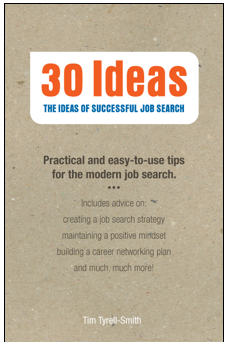
30 Ideas – The Ideas of Successful Job Search

March 4, 2011 By Miriam Salpeter

Job seekers don’t have to look very far to find advice. Book stores and the Internet are filled with ideas about strategies, tools and tips to help people find jobs. What is different about my colleague Tim Tyrell-Smith’s book, 30 Ideas: The Ideas of Successful Job Search, is his perspective as a hiring manager and a former job seeker. He was inspired to share his 30 ideas based on his own experiences.

He explains his job search focus is on “working with a purpose throughout the process…there’s little room for impulse decision-making. It is about efficiency and structure.” A bonus? His background is in consumer marketing (22 years). In case you didn’t already know — finding a job is all about marketing, branding and communicating, so Tim’s experience is invaluable.

30 Ideas offers both practical advice and important reminders.

For example, we know it’s difficult to maintain a positive mindset while job hunting. We also know how invaluable it can be to face the challenge with an optimistic attitude. Tim empathetically provides numerous suggestions to help job seekers keep an upbeat focus, including:

  • ideas to create an actionable strategy
  • reminders to embrace some of your “free” time to recharge your batteries
  • specifics to consider, even on the worst days
  • tips to overcome irrational fears
  • how to avoid the “out of work” stigma

In addition to these important reminders, Tim takes his readers through practical job search networking steps, offering advice about:

  • how to tell your network what you want
  • whom to target for networking
  • how to handle networking events
  • when to readjust your “pitch” — and how
  • what NOT to do when you network (which could be as important as what TO do)

Tim’s book is a great resource for job seekers who need a boost and some real-life, honest-to-goodness advice to remind them they can make a difference in their job hunts. Be sure to also visit Tim’s website/blog, where he offers frequent insights for job seekers — extending the advice in the book and interacting with his readers. You may also be interested in Tim’s LinkedIn group, Tim’s Strategy – Ideas For Job Search, Career And Life, where a community of job seekers and advisors share ideas and suggestions.

Learn more about 30 Ideas on Tim’s site and order it HERE via AMAZON or HERE for Kindle.

Tim generously offered to send a copy of his book to one of my readers! Comment below with a tip for job seekers based on your experience or a question!


Filed Under: Career Advice, Career Books, Drive Your Career Bus Tagged With: 30 Ideas, career coach, get a job, how to find a job, keppie careers, Miriam Salpeter, social media coach, Tim Tyrell-Smith

Why you need your own website – and how to get one!

February 20, 2011 By Miriam Salpeter

Do you believe you need an online presence to help you land a job — or to help you manage your career? I spent 45 minutes last week trying to convince a career-changing friend she needed HerName.com. She is finishing an advanced degree and will be looking for opportunities in a teaching specialty. She can’t understand why it is important to have an online presence, and she made some good points:

  • I’m going to get a job because my professor recommends me to a colleague; it doesn’t have anything to do with having a website.
  • I’m not comfortable having information about me online that just anyone can find.

I tried my go-to reasons to explain why her own site was a good idea:

  • Even if your professor recommends you for the job, it’s likely the hiring manager will also Google you. What will she find?
  • A personal site is a way to control how your name appears online.
  • Statistics show your online presence matters, and that employers are looking for personal and professional data about you.
  • In fact, while you may think you have “privacy” online, NOT putting up your own site only gives people an incentive to look deeper in the web for information about you. Take a look at these sites to learn what the “deep web” knows about you: pipl.com, Polymeta.com.
  • Managing a site is important for career insurance and professional development. Showcasing your expertise online (even if it is in a new field) helps demonstrate what you have to offer, even when you aren’t looking for a job. An online presence can grow and change along with your career and help attract people to learn more about you. This could result in opportunities to speak at conferences or events, or even invitations to apply for jobs down the road.

None of this persuaded her. Finally, I came up with one last point…Something I’ve written about, but hadn’t thought to bring up during our conversation:

  • Having a website suggests you have some technical savvy and understand how to use online tools to communicate. That, in and of itself, is an important skill many employers value. It’s known as “social proof.” You may say you know about technology on your resume, but actually using it to showcase your own information goes a long way to prove you have what employers want.

Finally! She replied…”I can see how that would be important.” Noting technology in the classroom is key, and knowing how to use it could be useful, she acknowledged the “social proof” argument was more persuasive than anything else I said.

Especially if you are transitioning to a new job or an experienced job seeker who needs to overcome age discrimination, having an up-to-date online presence and maybe even a viable blog helps show prospective employers you’re willing to learn and are perfectly capable of keeping up with technology.

Maybe you, like my friend, are skeptical. You can’t envision how and why having an online presence will help you get a job, manage your career or become known as an expert in your field. Since I spend so much of my time keeping up with job search strategies and researching tools job seekers and careerists need to use, it’s so clear to me that having YourName.com is crucial to your professional identity and to managing your career.

That’s why I created a product/service to help people (even the skeptical ones) secure and manage their own websites. I’m giving it away for a steal (a colleague told me I should be charging $1000+). Think about how your investment can help you move in the right direction for your career and visit my new site to learn how to get a social resume: http://www.getasocialresume.com/.

photo by nyuudo

Filed Under: Job Hunting Tools, Resume Advice, social media, Social Networking Tagged With: career coach, get a job, how to find a job, Miriam Salpeter, social resume, why you need an online presence

  • Page 1
  • Page 2
  • Page 3
  • Go to Next Page »

Follow Us!

  • Facebook
  • Instagram
  • LinkedIn
  • Pinterest
  • Twitter

Be an Insider: Sign Up to Receive Special Offers & Free Gift


About Keppie Careers

Are you a job seeker or business owner? You’ve come to the right place!
Click here to find out more.

Contact Us

Have a question or comment?
Click here to Contact Us.
© Copyright 2024 Keppie Careers