
• Skip to primary navigation
  • Skip to main content
  • Skip to footer

Keppie Careers

Social media speaker, social media consultant, job search coach

  • About
    • Expert Job Search and Social Media Consultant / Speaker
  • Services
    • For Job Seekers
    • For Entrepreneurs
    • Social Media Coaching and Consulting
    • Speaking/Keynotes
  • Resources
    • Sample Resumes
    • Quoted In
  • Books
  • Blog
  • Contact

Why you should use Twitter

March 3, 2011 By Miriam Salpeter

Anyone who knows me or reads my blog regularly already recognizes I’m a big fan of Twitter. It provides unprecedented access to and information from people you want to contact — and the people you want to know you!

A story illustrating the point:

I receive many, many emails from people (often PR firms) about career related books, products and applications. When I started receiving these, I responded personally to each, no matter how strong or weak the pitch. It seemed the polite thing to do. However, when I started getting several a day, I stopped even reading a lot of them. Like a typical employer might handle a resume, I only read it all the way through if it really caught my eye. (That’s another blog post altogether.)

What does this have to do with Twitter? Since I actively use and engage with people on Twitter, if someone there asks me a question, retweets my links, or generally touches base with me there, I respond. So, when a Twitter follower with a company he is promoting to career coaches touched base via Twitter, I DM’d (direct messaged) a private note asking him to email me, and I read the note and agreed to speak to him.

When we talked (maybe not a coincidence that I was really glad to learn about his product), I mentioned I don’t usually respond to inquiries, but remembered he came to me first from Twitter. He explained he knew the follow up email asking for our agenda was important, and he made sure it was targeted and intriguing enough to solicit my continued follow through.

The perfect 1 – 2 punch – a Twitter introduction/touch base and a targeted follow through via email. I’ll probably be writing more about this company going forward (it’s not the right time), but there’s no doubt this is a great lesson for job seekers about how to reach out to people who aren’t so inclined to talk to you.

Think about how Twitter can open doors leading to your success!

Stay tuned for another story of a successful pitch…Useful for entrepreneurs and job seekers!

photo by Paul Snelling
Filed Under: Career Advice, Social Networking

LinkedIn adds new functionality to ‘Company’ search

February 26, 2011 By Miriam Salpeter

LinkedIn’s blog reported yesterday that you can now search “for companies not only by attributes such as location, industry, and size but also by how you are connected. You can filter a set of results to include only those companies where you have a direct connection or broaden your search to include companies in your extended network.”

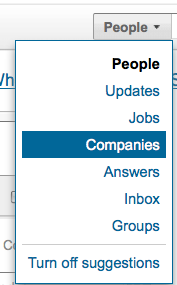
Hopefully, you have already been following companies (read more about following companies on LinkedIn here), but this is a pretty neat improvement. All you need to do is go to the top toolbar, select companies (see picture) and include keywords (which could be city, industry, etc.). LinkedIn finds a list of companies with your criteria where you have connections in your network. LinkedIn links you to those contacts and lets you know which companies currently list jobs in LinkedIn.

You’ll also have a chance to follow the company, which helps you track what is going on there. Take a look at LinkedIn’s video describing the new search function:

http://www.youtube.com/watch?v=1j5VoN_v-Us&feature=player_embedded

I think job seekers (or anyone thinking of making a change) will find this new functionality extremely useful! Be sure to keep up with The LinkedIn blog for updates.


Filed Under: Job Hunting Tools, social media Tagged With: career coach, how to find a job, how to use linkedin to find a job, keppie careers, linkedin, Miriam Salpeter, social media coach

Why you need your own website – and how to get one!

February 20, 2011 By Miriam Salpeter

Do you believe you need an online presence to help you land a job — or to help you manage your career? I spent 45 minutes last week trying to convince a career-changing friend she needed HerName.com. She is finishing an advanced degree and will be looking for opportunities in a teaching specialty. She can’t understand why it is important to have an online presence, and she made some good points:

  • I’m going to get a job because my professor recommends me to a colleague; it doesn’t have anything to do with having a website.
  • I’m not comfortable having information about me online that just anyone can find.

I tried my go-to reasons to explain why her own site was a good idea:

  • Even if your professor recommends you for the job, it’s likely the hiring manager will also Google you. What will she find?
  • A personal site is a way to control how your name appears online.
  • Statistics show your online presence matters, and that employers are looking for personal and professional data about you.
  • In fact, while you may think you have “privacy” online, NOT putting up your own site only gives people an incentive to look deeper in the web for information about you. Take a look at these sites to learn what the “deep web” knows about you: pipl.com, Polymeta.com.
  • Managing a site is important for career insurance and professional development. Showcasing your expertise online (even if it is in a new field) helps demonstrate what you have to offer, even when you aren’t looking for a job. An online presence can grow and change along with your career and help attract people to learn more about you. This could result in opportunities to speak at conferences or events, or even invitations to apply for jobs down the road.

None of this persuaded her. Finally, I came up with one last point…Something I’ve written about, but hadn’t thought to bring up during our conversation:

  • Having a website suggests you have some technical savvy and understand how to use online tools to communicate. That, in and of itself, is an important skill many employers value. It’s known as “social proof.” You may say you know about technology on your resume, but actually using it to showcase your own information goes a long way to prove you have what employers want.

Finally! She replied…”I can see how that would be important.” Noting technology in the classroom is key, and knowing how to use it could be useful, she acknowledged the “social proof” argument was more persuasive than anything else I said.

Especially if you are transitioning to a new job or an experienced job seeker who needs to overcome age discrimination, having an up-to-date online presence and maybe even a viable blog helps show prospective employers you’re willing to learn and are perfectly capable of keeping up with technology.

Maybe you, like my friend, are skeptical. You can’t envision how and why having an online presence will help you get a job, manage your career or become known as an expert in your field. Since I spend so much of my time keeping up with job search strategies and researching tools job seekers and careerists need to use, it’s so clear to me that having YourName.com is crucial to your professional identity and to managing your career.

That’s why I created a product/service to help people (even the skeptical ones) secure and manage their own websites. I’m giving it away for a steal (a colleague told me I should be charging $1000+). Think about how your investment can help you move in the right direction for your career and visit my new site to learn how to get a social resume: http://www.getasocialresume.com/.

photo by nyuudo

Filed Under: Job Hunting Tools, Resume Advice, social media, Social Networking Tagged With: career coach, get a job, how to find a job, Miriam Salpeter, social resume, why you need an online presence

How to find the work you love

February 13, 2011 By Miriam Salpeter

Today, I’m happy to share a bit of “love” from my colleague, Sital Ruparelia. Sital wrote this poem to help careerists everywhere think about what they want to do next…and how to get there. Learn more about Sital via his site: www.SitalRuparelia.com/blog.

Roses are red, violets are blue
Here’s a Valentines poem, I wrote just for you

Maybe you’re searching for “the one” job you’ll truly love
A job so special, it fits like a glove

Maybe you’ve set your sights on becoming a career changer
To start a new business and become an entrepreneur

Or maybe you’re just looking for one last romance
To grab some “me time” and precious work-life balance

Alas, the secrets of career success are no different to finding personal joy
Where the winners get nowhere by being shy and coy

To find that job, promotion or brand new lifestyle
You need to step up a gear and go the extra mile

Step out of your comfort zone and step out onto the wire
Take some risks and the occasional flyer

Stop hiding behind your inexperience and personal history
And build a competitive advantage around your unique story

Stop procrastinating and waiting for your ducks to line up in a row
The time will never be “right” – so go on, just have a go!

Stop putting off the dream until “someday”
When the best time to get started is, in fact, today

The world is waiting for you to do the work you love
And maybe this poem is “the sign” you’ve been waiting for, from “up above”

For today is Valentine’s Day, a time for celebrating great romances
So start scaring yourself by taking a few more chances

Happy Valentines day folks,

Sital Ruparelia

If that doesn’t inspire you to start thinking about creating your own future, I don’t know what will! 🙂

If you’re interested in a social resume (YourName.com) to start you off on the right path, be sure to visit my new site: YouNeedASocialResume.com.

photo by jikido-san

Filed Under: Career Advice, Career/Life Balance Tagged With: career coach, do you love your job, how to find a job, how to find a job you love, keppie careers, Miriam Salpeter, Sital Ruparelia

Be a go-giver — it improves your career prospects and so much more!

February 9, 2011 By Miriam Salpeter

“Every March 28th, I make two phone calls — one to the person who took a chance and hired me in 2003 and one to the person who taught me to drive on the other side of the road when I came to the U.S. from Singapore.”

If you knew Lynn Wong, you wouldn’t be surprised that she remembers those important people in her life! I met Lynn via an introduction from my friend, Jenny DeVaughn. (That’s not very surprising, as I’ve written about how Jenny is a connector.) After spending some time with Lynn, who is on a brief work hiatus before she begins a job as senior manager in global logistics at a Fortune 500 company, I knew she’d have a lot of terrific ideas to share, so I asked if she’d let me interview her about a few key topics that interest both of us:

  • Emotional intelligence as it pertains to the job search and working world
  • Networking — how to do it well and make it effective, even if it doesn’t appeal to you
  • General tips and advice from someone who has interviewed a lot of candidates

I hope I can do our interview justice! Lynn shared a lot of gems…

When we first met, Lynn mentioned one of the reasons she was invited to interview for her new position was because she had spent time at a social event years ago with a senior executive she knew. He remembered their conversation and having worked with her and suggested her name (a few years later) as a possible candidate for her new  position. After a series of interviews and meetings, Lynn earned the job.

Was it pure serendipity that things turned out so well for Lynn’s career? Not entirely. After spending time with her and learning about her goal to always be “as kind to as many people as she can,” — with a focus on being “kind and consistent with integrity,” it’s easy to see one factor in her success is her emotional intelligence. As a manager, she believes emotional intelligence, in particular, empathy, is key to thriving in globalized and matrixed teams that have become the norm in many organizations.

She explained, “What does it mean to be successful? You cannot be everything to everyone, but you can care for people holistically. If you don’t get to know people, you won’t be able to bring out the best in them…It’s important to find common ground (between colleagues) in order to build winning teams, achieve consensus and move forward.”

Lynn points to self-awareness, another aspect of emotional intelligence, as crucial to success in the workplace. How can you become more self-aware? She suggests reading two books, Brag! by Peggy Klaus and Little Book of Big Networking Ideas, by Nadia Bilchik. Brag helps effectively develop “brag bites” to share experiences and Little Book teaches how to make meaningful connections by becoming a “go giver.” Tips from both books help networkers build bridges to other people.

One thing Lynn looks forward to when she begins her new job is being able to meet and ask her colleagues their stories — not only what do they do, or what is their role in the organization, but how they got there, what they enjoy and what keeps them coming back. She’ll file their stories in her mind and revisit them later if an occasion arises for her to connect them with others for personal or professional growth.

I asked Lynn for tips to help people learn to make a strong connection with strangers while networkng. She suggested thinking of touchpoints that connect all of us — but don’t necessarily have anything to do with work. In particular, focus on what you have to give. Her suggestions:

  • Food connects people — where can you get the best wings in town? What’s your favorite recipe? (Not surprisingly, this is a big topic on Twitter and Facebook!)
  • Sports
  • Where to get tickets for events
  • Vacation spots
  • Great websites and online resources

How do you bring these topics up in conversation? Lynn suggests “playing host” at a networking event. If you’re uncertain or lonely, no doubt there are others feeling the same way. Find two people and act like it’s your party — introduce them to each other. Ask what brings them there and ask questions about themselves. (Feel free to bring up your key touchpoints you like to talk about.)

Lynn explained the skills you need to successfully network and to consistently make a connection with new people — self-awareness and being in touch with your strengths and your limitations (and knowing how to acknowledge them) — overlap significantly with successful managerial and interviewing skills.

For example, she suggests candidates must be able to use “I” and “we” statements appropriately in an interview. When she interviews a candidate who uses only “we” statements — “We created…We initiated…We accomplished…,” she wants to know the candidate’s role in the team’s success. However, using only “I” statements does not serve an applicant well, either. Weaving them together, for example, “I partnered” or intermingling them as necessary provides the interviewer a sense you know what you offer and how it relates to working with other people.

The best interview preparation? Lynn appreciates hearing stories — including humor, and even a punchline (as long as it is appropriate, maybe even a little self-deprecating). While no one wants to hear your autobiography, a brief, funny story from your childhood that illustrates a quality you want to show, followed by explaining how you use that skill today, may be well received and help make you more memorable.

Lynn suggests preparing stories to address topics from your resume, but also preparing how to answer typical interview questions, since most interviews do tend to ask for similar insights. (As for the weakness question — know your weakness and explain what you are doing to work on it.) Be ready for anything in an interview, and don’t be intimidated if a panel evaluates you. As Lynn notes, “You need to be able to talk to several people at once in a job setting.” So, it makes sense to incorporate a panel to evaluate you. (Plus, she explains, sometimes a candidate who isn’t right for one hiring manager is perfect for another position.)

Networking does not have to be stressful and intimidating. Lynn does not attend networking events; she built her connections through active volunteerism in her company and community. She explains, “When you meet someone working for a cause, chances are good that you will make a meaningful connection, because you already have the cause in common…When people are stripped of their corporate and work personas, you really learn what makes people tick.”

Lynn believe is “paying it forward” and being a go-giver of ideas and connections whenever she can. Being a valuable resource to other also means becoming the “go-to” person over time in your niche or community. Lynn notes, “This role pays you back many times, because others begin to seek you out to share ideas and connections.” As Lynn says, “Good people beget good people.” Her go-giving philosophy ties into her belief that connecting with others is a way of life, not just restricted to sharing contacts on LinkedIn or swapping business cards. She notes, “You can smell it when someone is networking to get something from you versus making a genuine connection. Why would you share a precious resource with a stranger until you make a real connection?”

Take a lesson from Lynn — think about how you can manage your career by focusing on how you engage with people everyday. Your success may depend on it!

Filed Under: Career Advice Tagged With: Brag!, how to find a job, how to manage your career, how to network in person, keppie careers, Little Book of Big Networking Ideas, Lynn Wong, Miriam Salpeter, Nadia Bilchik, Peggy Klaus

  • « Go to Previous Page
  • Page 1
  • Interim pages omitted …
  • Page 97
  • Page 98
  • Page 99
  • Page 100
  • Page 101
  • Interim pages omitted …
  • Page 214
  • Go to Next Page »

Follow Us!

  • Facebook
  • Instagram
  • LinkedIn
  • Pinterest
  • Twitter

Be an Insider: Sign Up to Receive Special Offers & Free Gift


About Keppie Careers

Are you a job seeker or business owner? You’ve come to the right place!
Click here to find out more.

Contact Us

Have a question or comment?
Click here to Contact Us.
© Copyright 2024 Keppie Careers