• Skip to primary navigation
  • Skip to main content
  • Skip to footer

Keppie Careers

Social media speaker, social media consultant, job search coach

  • About
    • Expert Job Search and Social Media Consultant / Speaker
  • Services
    • For Job Seekers
    • For Entrepreneurs
    • Social Media Coaching and Consulting
    • Speaking/Keynotes
  • Resources
    • Sample Resumes
    • Quoted In
  • Books
  • Blog
  • Contact

Prepare in advance for the job that may come knocking

June 21, 2011 By Miriam Salpeter

Last week, a prospective client contacted me. He was thinking about solidifying his “personal brand” and thought he could use some help firming up his job search plans. We spoke briefly, I explained how I could help him identify the stories that would relate and appeal to his target audience and how I could teach him to propagate those stories via social media. I agreed to outline a strategy/proposal while he interviewed other coaches (!), but the next thing I knew, he was contacting me with an urgent email:

“My dream job just came knocking on the door.”

All of the sudden, a longer-term, “let’s think about it” plan became an immediate need — how to impress the telephone screener to land a chance at an interview for the job he’d been yearning to have. (Incidentally, this was the second client in a week I’d convinced NOT to offer to “scrub toilets” for the privilege of working someplace!)

Luckily, I was able to schedule a just-in-time coaching session and identified the salient points from the job description I believed would be most valuable to highlight and discuss in an introductory meeting. Success! The meeting went well; the client is waiting to firm a date for the second interview — and is ready for the next “just-in-time” session to help him hone in on what he wants to say.

Could this be you? Absolutely! Do you need to wait to the 11th hour to get some help to get you where you want to go? No! Start preparing now.

Are you ready to present yourself — in line with what your audience wants to hear? Could you pass an initial screen? If not, maybe it’s time for a coaching session?

photo by Feuillu

Filed Under: Career Advice, Interviewing Tagged With: career coach, career expert, how to find a job, keppie careers, Miriam Salpeter

Important information about work-life fit/flexibility

June 16, 2011 By Miriam Salpeter

One issue for many job seekers is landing an opportunity offering “flexibility,” “balance,” or, what consultant,  Cali Williams Yost, CEO and Founder of Flex Strategy Group and author of Work+Life: Finding the Fit That’s Right for You, would call “work-life fit.”

Today, I’m happy to share research Cali sent me from from the 2011 Work+Life Fit™ Reality Check Survey. It illustrates that, “Work life flexibility is no longer a bright, shiny, novelty item that only a few people have.  In fact, most full-time employees have some form of work life flexibility and they are much less afraid to use it than they were five years ago.”


The following tips are directly from survey findings to help you get the most out of the work life flexibility that’s become a foundational part of the way we live and work:

Tip 1: Don’t let too much work and too little time keep you from work life flexibility, instead use that flexibility strategically to get your work done and have a life. When asked, respondents ranked “increased workload or no time for flexibility” as the top obstacle (29%) that kept them from using or improving their work life flexibility.  Looked at another way, flexibility could also be the key to managing that greater workload and having more time for the other parts of your life.  A periodic shift in hours, or working from home now and then could restore a sense of productivity and well-being.  Be creative.

Tip 2: Remember that work life flexibility comes in many forms.  It includes both day-to-day, informal ad hoc shifts in how, when and where you work, as well as formal plans that officially change your work+life fit. Even though 62% of respondents said they had some type of day-to-day, ad hoc flexibility, it’s easy to take it for granted as a given.  Use it thoughtfully and strategically to manage the way work fits into your life every day. If you are interested in more formal plan, learn ahead of time how to present a proposal that’s a win for you and the business.

Tip 3:  To make informal, day-to-day flexibility a success for you, your team and the business, make sure to communicate and coordinate with all of the key stakeholders, not just your supervisor. According to the survey, when respondents made occasional changes in how, when and where they work, they discussed those changes with:

  • 79% their supervisor
  • 63% their spouse, family or partner
  • 52% their colleagues
  • 45% those they supervise, and
  • 7% no one.

You don’t need to tell your colleagues and those you supervise why you are using flexibility, but let them know how the work will get done and how they can reach you if needed.

Tip 4: Challenge any lingering fears that may be keeping you from using or improving your work life flexibility. Make sure any fear or concern is based on fact, not invalid assumptions.  The good news is that individuals are much less likely to let fear or negative perceptions keep them from using or improving their flexibility than they were in 2006:

  • You might make less money:  21% in 2011 versus 45% in 2006
  • You might lose your job:  16% in 2011 versus 28% in 2006
  • Others will think you don’t work hard:  11% in 2011 versus 39% in 2006
  • You worry that your boss would  say “no”:  13% in 2011 versus 32% in 2006

However, obviously some fears and concerns linger.  Learn about the compensation policy related to flexibility where you aren’t working less, just differently.   Understand the employment climate in your organization.  Make sure you continue to work hard, communicate and coordinate well (see Tip 3) and learn how to present a flexibility plan that’s a win-win and hard to turn down.

Tip 5: Understand that work life flexibility is more than a perk, or benefit.  It’s a strategy that your employer can use to “retain talent, manage workload and grow.”  And without it, the business will suffer particularly in the areas of health/wellness, morale and productivity.  One of the surprising findings for the 2011 Work+Life Fit Reality Check is how many respondents either think work life flexibility is a “perk or benefit” (36%) or “don’t know” what it is (14%).  Just as work life flexibility can help you strategically manage your workload and resources, it can also benefit the business in other areas.  Specifically, a majority of respondents (66%) felt that without work life flexibility health (48%), morale (41%) and productivity (36%) would suffer.

For more details and to download the study, visit Work Life Fit Tips.

You may also want to read a study addressing the issue of inevitability of work-life flex, Findings from the Flexpaths – LinkedIn study.

photo by ellajphillips

Filed Under: Career Books, Drive Your Career Bus Tagged With: balance at work, Cali Williams Yost, career coach, career expert, how to find a job, keppie careers, Miriam Salpeter, work flexibility, work+life fit reality check survey

How having your own website helps you

June 14, 2011 By Miriam Salpeter

I always think one of the most frustrating aspects of job search is believing you’ve “done everything,” but aren’t finding an opportunity. I’ve never met a job seeker who actually has “done everything,” though, which I think is good news! Most people are very focused on out-dated tools and spend a disproportionate percentage of their time doing the same thing, over and over, without different results.

This month, the Career Collective (a community I co-coordinate with my colleague Jacqui Barrett-Poindexter) addresses the question of how to use social media in a job search. (Please click through to the links I’ll add soon at the bottom of this post to the other responses to this question.)

There are so many great ways to use social media in your search, most of which I address in my book, Social Networking for Career Success.

There’s no doubt social media tools offer an underutilized opportunity to:

  • Help you connect with new people and keep track of contacts.
  • Easily learn new things.
  • Share your expertise and expand your brand.

LinkedIn, Twitter and Facebook all provide easy-to-use, free tools to get-in-touch (and keep-in-touch) with people who may be interested in learning more about you and what you have to offer. However, I think the best, and most important tool the majority of job seekers do not have is a personal website, or social resume.

Why have your own website?

  • Hiring managers will Google you. What will she find?
  • A personal site is a way to control how your name appears online.
  • Statistics show your online presence matters, and that employers are looking for personal and professional data about you.
  • NOT putting up your own site only gives people an incentive to look deeper in the web for information about you. Take a look at these sites to learn what the “deep web” knows about you: pipl.com, Polymeta.com.
  • Managing a site is important for career insurance and professional development. Showcasing your expertise online (even if it is in a new field) helps demonstrate what you have to offer, even when you aren’t looking for a job. An online presence can grow and change along with your career and help attract people to learn more about you. This could result in opportunities to speak at conferences or events, or even invitations to apply for jobs down the road.
  • Having a website suggests you have some technical savvy and understand how to use online tools to communicate. That, in and of itself, is an important skill many employers value. It’s known as “social proof.” You may say you know about technology on your resume, but actually using it to showcase your own information goes a long way to prove you have what employers want.

Especially if you are transitioning to a new job or an experienced job seeker who needs to overcome age discrimination, having an up-to-date online presence and maybe even a viable blog helps show prospective employers you’re willing to learn and are perfectly capable of keeping up with technology.

In my book, I suggest starting out using WordPress.com to try out an online presence. It’s a great resource, and it’s free. However, there are limitations to free tools — not the least of which is you don’t really “own” that online real estate. With some know-how, or an investment in someone who does know how, you can have your own site. If you’re lucky, you can even have “YourName.com,” which will help you rank high for your name in search and help direct people to find the information you want them to find about you.

I hope you’ll visit my site, GetASocialResume.com, to learn more about what you’ll want to include in your social resume. If you don’t want to figure out how to do this yourself, I can help. With a relatively small investment, I can offer you an online presence you’ll be proud to use as a hub for your social media activity, and help you create a site to tell a compelling story describing your background and experiences.

The following are posts from other Career Collective members answering this question

Make Your Career More Social: Show Up and Engage, @WalterAkana

You 2.0: The Brave New World of Social Media and Online Job Searches, @dawnrasmussen

How to Get a New Job Using Social Media, @DebraWheatman

Social Media: Choosing, Using, and Confusing, @ErinKennedyCPRW

How to Use Social Media in Your Job Search, @heatherhuhman

Updating: A Social Media Strategy For Job Search, @TimsStrategy

Your Career Needs Social Media – Get Started, @EliteResumes @MartinBuckland

We Get By With a Little Recs from Our Friends, @chandlee

Expat Careers & Social Media: Social Media is Potentially 6 Times more Influential than a CV or Resume, @expatcoachmegan

Social-Media Tools and Resources to Maximize Your Personalized Job Search, @KatCareerGal

Job Search and Social Media: A Collective Approach, @careersherpa

Social Media: So what’s the point?, @DawnBugni

Tools that change your world, @WorkWithIllness

HOW TO: Meet People IRL via LinkedIn, @AvidCareerist

Effective Web 2.0 Job Search: Top 5 Secrets, @resumeservice

Jumping Into the Social Media Sea @ValueIntoWords

Sink or Swim in Social Media, @KCCareerCoach

Social Media Primer for Job Seekers, @LaurieBerenson


Filed Under: social media, Social Networking, Uncategorized Tagged With: career coach, Career Collective, get a job, get a website, how to find a job, how to get a job, how to use social media to get a job, keppie careers, Miriam Salpeter, social resume, why you need an online presence

How to be “Great on the Job,” a review

May 23, 2011 By Miriam Salpeter

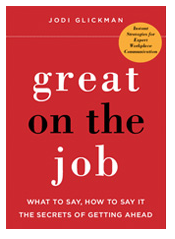
Communication — and communicating well, in business and in all circumstances — is key for career success. It’s not always easy to know what to say, and it certainly isn’t always obvious how to say it. Jodi Glickman’s new book, Great On the Job, comes to the rescue. Known as a strong, strategic communicator with many successful examples to back up her words, Jodi, who’s landed jobs due to her interviewing skills, even though she’s been told she was the “least qualified” of all the candidates, outlines how to communicate well for professional success.

Jodi teaches readers how to re-think the basics. (When’s the last time you re-evaluated how you introduce yourself on a phone call? Do you ask the person if it is a good time to talk?) to more advanced communication skills, including how to manage in a crisis, communicate about a missed deadline or how to recover when you aren’t prepared for a presentation).

She focuses on four concepts:

Generosity – thinking about the other person before you consider your own needs and focusing on how to make that person’s life better.

Initiative – being proactive without creating work for others, thus moving your career forward by “engaging in meaningful and productive work that contributes to the greater good” (p. xxiii).

Forward Momentum – creating, nurturing and sustaining personal relationships, even when you have no specific “reason” in mind, other than to just keep in touch.

Transparency – being honest when you mess something up and admitting when you don’t know something.

In easy-to-follow case studies, she describes scenarios and outlines exactly how to respond in each situation.

As a bonus, the book includes details about how to sell yourself. I loved the section, “Different Person, Different Pitch,” where Jodi outlines how important it is to identify which of your stories will resonate with your audience members. She explains, “Just as you probably have multiple online profiles — Facebook, Linkedin, Twitter — you should also understand that different situations warrant different pitches of stories.” She walks you through how to focus on determining what elements of your story to develop and use later.

To top it off, there’s a “cheat sheet” section at the end, outlining advice from each of the sections and reminding the reader of the salient points in each chapter. What a great resource for anyone reading the book and a way to be sure it’s easy to implement Jodi’s advice!

I highly recommend picking up a copy of Great on the Job to learn “what to say, how to say it — the secrets of getting ahead.”

Visit Jodi’s site to learn how to purchase a copy from your favorite bookseller.

Filed Under: Career Books, Communicating Tagged With: communicating at work, Great on the Job, how to communicate well, how to find a job, how to get a promotion, Jodi Glickman, keppie careers, Miriam Salpeter

Chosen as “Career Mastermind”

March 14, 2011 By Miriam Salpeter

I want to thank Dr. Randall Hansen and Dr. Kathy Hansen of Quintessential Careers for including me in their list of “15 Quintessential Careers Career Masterminds” in honor of the 15th anniversary of the founding of Quintessential Careers.

This is a real honor, as I have been using and recommending Quint Careers as a resource for my clients for just about that many years! I remember meeting Randall and Kathy several years ago at a conference — it was a “brush with career fame” for me, which makes this honor even more special.

Their announcement notes:

As part of the 15th anniversary of the founding of Quintessential Careers, we are honoring and celebrating some of our favorite career visionaries, gurus, and experts — people who truly want to help job-seekers understand and succeed in the job-search.

We’ve selected these 15 career experts, folks we are honoring with the title of Quintessential Careers Career Masterminds, because of their career and job-hunting know-how — and their passion for sharing that knowledge with job-seekers, career-changers, and the entire career community.

It’s especially nice to be recognized for sharing information and resources with the career community, so thank you very much!

Learn about everyone on the Quint Careers list and stay tuned for our involvement on the site in the coming months!

Filed Under: Quoted in... Tagged With: 15 Quintessential Careers Career Masterminds, career coach, career resources, Dr. Kathy Hansen, Dr. Randall Hansen, how to find a job, job search, keppie careers, Miriam Salpeter, social media coach

  • « Go to Previous Page
  • Page 1
  • Interim pages omitted …
  • Page 19
  • Page 20
  • Page 21
  • Page 22
  • Page 23
  • Interim pages omitted …
  • Page 31
  • Go to Next Page »

Follow Us!

  • Facebook
  • Instagram
  • LinkedIn
  • Pinterest
  • Twitter

Be an Insider: Sign Up to Receive Special Offers & Free Gift


About Keppie Careers

Are you a job seeker or business owner? You’ve come to the right place!
Click here to find out more.

Contact Us

Have a question or comment?
Click here to Contact Us.
© Copyright 2024 Keppie Careers