• Skip to primary navigation
  • Skip to main content
  • Skip to footer

Keppie Careers

Social media speaker, social media consultant, job search coach

  • About
    • Expert Job Search and Social Media Consultant / Speaker
  • Services
    • For Job Seekers
    • For Entrepreneurs
    • Social Media Coaching and Consulting
    • Speaking/Keynotes
  • Resources
    • Sample Resumes
    • Quoted In
  • Books
  • Blog
  • Contact

How to manage your time and life

June 16, 2016 By Miriam Salpeter

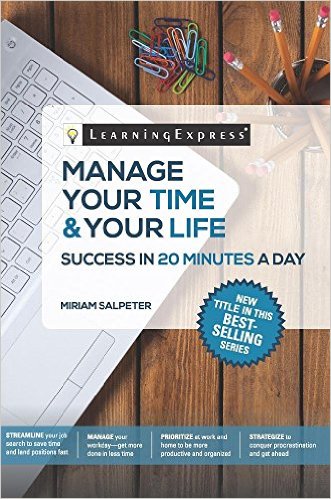
Time and LifeAre you overwhelmed by life’s details? Whether you’re looking for a job, or you’re fully ensconced in a career, do you feel like you’re always running to catch up, and never completely in control of your day-to-day work and home life? I wrote a new book just for you!

Manage Your Time & Your Life: Success in 20 Minutes a Day provides suggestions and recommendations to help you make the most of every hour of the day. The result? You’ll have more time for everything that matters to you, and you’ll be able to successfully achieve your professional goals. No one has time to waste! That’s why this book starts out by illustrating how to network effectively and how to choose the best jobs to apply for to avoid the dreaded “resume black hole,” when employers ignore you. (After all, you never know when you’ll want to look for a new opportunity.) If you already have your dream job, you can dive directly into the slew of best practices and ideas included in the majority of the book, which is dedicated to helping manage your time for professional success.

In this book, I cover the entire gamut: from how to incorporate healthy routines (such as what to eat and how to make time to exercise) to how to set and achieve your aspirational work goals. Whether you need help organizing your office, managing distractions at work, tracking your emails or keeping a useful checklist and calendar, this book provides practical insights, exercises to get you started and information to help.

You haven’t been tracking your “wins” at work, or you don’t know what apps you should use to make the most of your time and avoid being distracted? I’ve got you covered!

Manage Your Time & Your Life: Success in 20 Minutes a Day is an all-in-one efficiency “bible,” with suggestions to help you identify key action items and take the necessary steps to accomplish your long- and short-term goals. Learn how to get a firm handle on your schedule to keep efficiently moving forward with your professional plans.

  • Do you need help separating your “must do” from your “want to do” items?
  • Could you use help to overcome procrastination and learn to become accountable for your plans?
  • Would you appreciate advice about how to stop wasting time, effort, and energy?

This book includes techniques and ideas to help you get organized and keep on track.

For example, learn how to:

  • Plan your job search — get it done in less time
  • Prepare for interviews — without memorizing answers to hundreds of questions
  • Make the most of your time at work
  • Get organized and feel in control of your life
  • Create useful lists and prioritize
  • Avoid procrastination
  • Much, much more!

Download an excerpt from the book: How to Avoid Procrastination.

After you read this book, you will be able to quickly review your progress, assess your strategies and make positive changes. Are you ready to put the right combination of action items in place and just get things done? Order the book today (it ships on July 7th) and get started!

Be sure to touch base to let me know what questions you have, and feel free to share your favorite productivity tips in the comments! Post on social media using the hashtag #TimeLife.

Don’t miss my other new book, Write & Speak Like a Professional: Success in 20 Minutes a Day.

Filed Under: Career Advice, Career Books Tagged With: best career advice, keppie careers, Manage your time and your life, Miriam Salpeter

Tired of job hunting? Start a business instead!

April 11, 2016 By Miriam Salpeter

social-network-vector-with-icons_23-2147497527If you’re thinking about starting a business or hanging a shingle, you’ve probably considered how to improve efforts to tap into social media and to use social networks to help promote your business, product or service.

Statistics detailing social media business opportunities via social networking

The statistics are pretty compelling. GrowingSocialMedia.com featured these numbers in a recent roundup:

  • According to Statistica, the number of global social media users is expected to reach 2.5 billion in 2018.
  • Pew Research Center found that 90% of adults age 18 to 29 use social media. (Although, that seems low!)
  • We Are Social Media found 71% of women are active on social media, compared to 62% of men.
  • Perhaps most importantly for business owners: 92% of small business owners who use social media believe social media marketing is important for their business, according to Business2Community.

Neoteric UK compiled more great stats in an info graphic referenced on We Are Social Media. They noted:

  • The fastest growing group of new users on Twitter are between 55 and 64 years old.
  • 45% of users feel “worried or uncomfortable” when email and Facebook are inaccessible.
  • The +1 button (on Google+) is hit at least 5 billion times per day.
  • 189 million of Facebook’s users are ‘mobile only’, thanks to smartphones

Does social media propel direct sales?

With these statistics in mind, you may think social media marketing is a great direct line for you to help sell your product or service. Post a few great insights on Facebook, and VOILA! – you’re a selling machine, right?

Not so fast.

Last week, Ad Week  reported about data from e-commerce vendor Custora analyzed between January and March, 2016. Reviewing about $100 billion in sales among 500 million shoppers, researchers identified only 1.5 percent of retailers’ last-click e-commerce transactions that came via social media. Of those, not surprisingly, Facebook dominated 81 percent of sales, while shopping-centric Pinterest generated 10.8 percent.

Why use social media marketing if it doesn’t produce direct-click sales?

Stay top-of-mind / inspire trust / leverage reviews

Why aren’t retailers dropping their Facebook, Pinterest, Instagram and other accounts and desperately searching for another marketing tool to guarantee sales? They realize social media isn’t about “selling.” Instead, it’s a vehicle to help stay top-of-mind for clients and customers.

In addition, leveraging these tools helps companies inspire trust in their target audience. Especially if you are a small business or are not well known, if you have a community of social media followers who are engaged and to whom you respond frequently, potential customers may be more likely to take a chance on making a purchase from you.

Social media is a great way to help encourage happy clients and customers to leave a positive review for you, which, in a buying environment where people look for online validation that their purchase is a good idea, is very useful to drive sales.

Teach Google what you want it to know and demonstrate expertise

Another, equally important reason to leverage social media as a business owner. These tools give even the smallest business the opportunity to feed content and information directly to Google and to “teach” the search engine what they want it to know.

In addition, using social media helps business owners demonstrate expertise and leverage credibility, which is especially important for consultants and coaches, but also for people selling products based on their knowledge. For example, if you are marketing a diet product, you’ll want to prove to your audience you know something about health. Similarly, if you’re selling exercise equipment, it will help inspire confidence in buyers if they can easily see your social media stream is full of content demonstrating you are an expert in the fitness field.

Even if you’re already making money online — tap into a bigger audience

Email marketers or those who rely mostly on Facebook ads and webinars to sell products and services may think they don’t need to leverage non-paid social media to get the word out. Certainly, if you can drive people to sign up for a webinar where you can demonstrate your expertise, you’re on the road to success. However, you’ll never know how many MORE people might have taken the time for your webinar or purchased your product if you had a credibility-boosting social profile.

Expand your network and access referrals and assistance

Yet another important reason for businesses and business owners to use social media tools is that they allow you to grow your network and meet new people who may be willing to promote you or your company to their network!
  • One new tool I’ve been checking out lately that fits in well with this model is called Brazzlebox. It’s a virtual community for small and home based businesses. Check out their video. Members of the community can easily network with other businesses nearby, and connect up with other businesses in the same industry. Members can post on the network, trade private messages or even give out coupons.
—
Option2I built my business using social media tools and I LOVE helping people figure out how to make the most of these resources. So, I launched a new program to help other entrepreneurs who want to stop wasting time on social media and start making money. The “Smart Business Owner’s Social Media Help Desk” is a private Facebook group where I teach entrepreneurs how to leverage social media to enhance their reputations, grow their brands, expand their businesses and make more money. Click through to learn more and access the limited-time offer bonuses!

Icon vector designed by Freepik

Filed Under: Entrepreneurs Tagged With: can social media help me make money, how to make money using social media, keppie careers, Miriam Salpeter, Smart Business Owner's Social Media Help Desk, social media for business, why use social media

Networking tip: where to find great information to share

March 2, 2016 By Miriam Salpeter

Ball social mediaIf you want to impress your online audience with your expertise, you’ll need to share useful and interesting content via your social networks. It can be a challenge, because you don’t have a lot of extra time to peruse many online sources to tap into the best resources to post on your various social networks. Luckily, there are many sites that provide useful, easy-to find information. These are some of my favorites.

LinkedIn’s Pulse

Find it under the “Interests” tab on your LinkedIn toolbar. You can choose to follow influencers, major media outlets and topical content areas. It’s extremely easy to share the content to LinkedIn, Facebook and Twitter right from Pulse.

Alltop.com

This is an online, virtual “magazine rack” of blogs. Use the search bar to identify topics that interest you and follow the blogs that produce the content to interest your audience.

SmartBrief.com

Offering many free subscriptions to online newsletters, Smartbrief editors read and cultivates what is published about topics of interest and sends newsletters with links to articles and brief summaries. They have newsletters covering health care, marketing, education, business, finance and more.

These are just three places to find useful content to share. Feel free to post your favorites in the comments!

Get my free white paper: 5 Mistakes Preventing You From Landing a Job This Week 

Read the whole post on Vault.com.

Get my book: Vault Guide to Networking

Filed Under: Networking Tagged With: keppie careers, Miriam Salpeter, Networking, Vault.com

How to Address Gaps in Your Work History

February 25, 2016 By Miriam Salpeter

GapDo you have gaps in your work history? Perhaps you were unemployed or took time off to spend with your family? No matter the reason for the gap, the best way to handle it is to address it on your resume so it does not raise a red flag for the employer.

Consider the following approaches to address gaps in your resume.

Avoid Gaps

Perhaps you weren’t working for an organization during a particular time, but that doesn’t mean you can’t include something to cover the time period. If you don’t already capture the “empty” dates via continuing education or a degree program, fill in the time slots by listing volunteer work or consulting. Describe what you did in terms most relevant to target employers, and they may not even notice the section technically covers a gap in work history. For example, if organizational skills are key for the job you want, and you served on your local school’s Parent-Teacher Organization running special events, include the information as you would any job.

In general, employers are most interested in knowing you’ve been active and involved in using key skills for the gap periods. Think back to times when you may not have been working and do the best you can to fill in those dates with descriptions on your resume.

Take Classes

Education and continuing education is a great reason for a work gap. If you think it won’t be clear why you have some otherwise unaccounted time on your resume, list your degree program or other classes in your experience section in addition to your education section. Provide detailed information about projects, especially group projects, and don’t forget to include skills you used to accomplish those goals.

Include Details in Your Descriptions

If you left a job for a specific reason, include some type of description in bullet points about that job. For example, if a company eliminated your entire department due to financial considerations, you may list it as a bullet point: “Company closed publication department due to budget issues.” It isn’t necessary to include this type of description unless you believe it absolutely necessary to explain an otherwise unexplainable gap in your resume.

Get my free white paper: 5 Mistakes Preventing You From Landing a Job This Week 

Be Prepared to Discuss Gaps

Sometimes, the best way to address a gap is to wait for someone to ask about it and to have a good story to tell. Keep in mind; if you have a gap in your resume, you are in very good company. Millions of people overcome this challenge, and so can you. Even if you were fired, you can explain away the situation in a positive way. Do not allow any negative feelings from the situation to come through when you’re connecting with a networking contact or potential employer. You don’t even need to specify you were fired. Instead, you may explain, “My employer and I had divergent ideas about how to handle the problems facing our organization, so I moved on.”

You’ll have explained the gap without raising any concerns.

How have you addressed you work history gaps? 


Filed Under: Career Advice Tagged With: gaps in work history, keppie careers, Miriam Salpeter

How to Tell Your Career Story So People Will Listen

February 17, 2016 By Miriam Salpeter

tell your storyStorytelling may seem like a topic more appropriate for preschoolers than job seekers, but the most astute and successful job seekers understand how important it is to be able to articulate an interesting and compelling story detailing their work history and accomplishments. Don’t underestimate the importance of outlining your background and describing it effectively. Hiring managers want to hear your story so you can prove you’re a good fit for the job.

Identify Your Relevant Skills

The first step to a great career story is to outline your best skills and accomplishments. What do you want people to know about your work history? How can you explain what you’ve done in your past in a way that convinces your target employer to want to hire you? You need to understand what you offer before you can decide how to market yourself. Think about examples of times when you navigated problems and challenges at work and when you delivered measurable results.

Get my free white paper: 5 Mistakes Preventing You From Landing a Job This Week 

One easy way to help you decide on a focus for your story is to study the job descriptions that interest you. Highlight all of the skills listed on the job description you’ve used. Use the highlighted skills to help you decide what parts of your story will interest the employer.

Mold Your Stories

With a list of skills and accomplishments that interest the employer, you can begin to outline your career story for each part of your job search.

Networking. Share your story in person and online. Showcase your best skills in your LinkedIn profile. Use the “Summary” to feature a conversational bio demonstrating what you do and why you’re good at it. You can use the first person (I, me or my) in the summary to speak directly to readers in LinkedIn. For example, if you’re in customer service, may say, “Growing up, I always helped all of my friends solve their problems. Today, I do it for a living.” When you meet in person, remember to tell your story succinctly and directly. No one is interested in long, drawn out tales about your skills and background. Narrow your story to a quick “pitch” of about 30-40 words at the most.

In your resume. All of your bullet points should focus on your career story. Include important information about how you solved problems by using the “PAR” method; include details about the problem, the action you took and the results you created. Focus extensively on the job description and incorporate keywords that match the employer’s needs when you explain why you are a good match.

In the interview. Don’t schedule an interview until you’re ready with several stories that will address typical interview questions. Use the “PAR” approach when you prepare so you’ll be able to discuss problems you’ve solved, explain how (what actions you took) and discuss results during the interview. Spend the majority of your time explaining how you overcame the problem and the rest of your time detailing the results of your efforts. Ideally, you’ll mention the long-term impact you had on your organization. For example, “One year later, the office is still following the protocols I instituted.”

Remember, in all cases, be brief, focus on results, address the items the employer wants to know and practice your stories so you’re able to flexibly adjust based on the situation and question. Once you identify the stories to tell, you’ll be well on your way to job search success!

Is it time to start your own business instead of look for a job? Join my new mailing list for useful information.

Filed Under: Uncategorized Tagged With: career story, how to get a job, keppie careers, Miriam Salpeter

  • « Go to Previous Page
  • Page 1
  • Page 2
  • Page 3
  • Page 4
  • Page 5
  • Interim pages omitted …
  • Page 174
  • Go to Next Page »

Follow Us!

  • Facebook
  • Instagram
  • LinkedIn
  • Pinterest
  • Twitter

Be an Insider: Sign Up to Receive Special Offers & Free Gift


About Keppie Careers

Are you a job seeker or business owner? You’ve come to the right place!
Click here to find out more.

Contact Us

Have a question or comment?
Click here to Contact Us.
© Copyright 2024 Keppie Careers