• Skip to primary navigation
  • Skip to main content
  • Skip to footer

Keppie Careers

Social media speaker, social media consultant, job search coach

  • About
    • Expert Job Search and Social Media Consultant / Speaker
  • Services
    • For Job Seekers
    • For Entrepreneurs
    • Social Media Coaching and Consulting
    • Speaking/Keynotes
  • Resources
    • Sample Resumes
    • Quoted In
  • Books
  • Blog
  • Contact

Should you eliminate buzzwords from your resume and online profiles?

December 16, 2010 By Miriam Salpeter

Job seekers can find a lot of “do” and “don’t” posts about their job hunt. Some of it is good advice, and other, while well meaning, may actually lead job hunters down the wrong path. A good case in point, LinkedIn’s recent post advising job seekers to avoid including any of the top 10 “buzz words” words in their profiles.

These are the most popular “overused buzzwords” in LinkedIn profiles in the U.S.:

1. Extensive experience
2. Innovative
3. Motivated
4. Results-oriented
5. Dynamic
6. Proven track record
7. Team player
8. Fast-paced
9. Problem solver
10. Entrepreneurial

LinkedIn also notes that popular words vary by region. (Not surprisingly!):

While members from the USA, Canada and Australia tend to emphasize their “extensive experience,” Brazilians, Indians and Spaniards identify themselves as “dynamic” professionals. Members in the UK call themselves more “motivated” and the French, the Germans, the Italians and the Dutch see themselves as “innovative.”

On the Career Trend blog, Rob Poindexter wrote about cliches, reacting to a news program, where all of the responses were trite:

Commentator:  What are your thoughts about the war in Afghanistan?
Panelist # 1:  All’s well that ends well.
Panelist # 2:  It’s not over ’til it’s over.
Panelist # 3:  One foot on a banana peel, the other in the grave.
Panelist # 4:  He who laughs last, laughs best.

Rob reminds readers not to let their resumes be a “cliche.” Absolutely good advice; you don’t want a resume that is nothing but buzzwords and devoid of quality content (like the commentators’ responses). But, is it time to do a search and destroy mission to eliminate all buzzwords from your resume and online profiles, as LinkedIn suggests?

Let’s think about it — why are these terms so popular? Because many of them describe exactly the type of person many employers want! So, take a step back and think about this before your revise your profile.

MSNBC’s career expert, Eve Tahmincioglu responded to LinkedIn’s post with a measured, and I believe appropriate answer. She asks, Are buzzwords really a bad thing?:

Admit it, you probably have one or two of these on your resume or LinkedIn profile. But is that really a bad thing? Who cares if they’re buzz words if they convey what you want?

I couldn’t agree more. Of course, if you read your profile and you list every single “cliche” without providing information that supports your claims, it’s probably time for a makeover. You need to show, not tell — focus your efforts on telling a story that is both about you and targeted to your next employer.

It’s not a good idea to “outlaw” words on resumes, even if they may be a little overused. Do I write resumes full of cliches? No, but I do target my clients’ resumes to their desired employers!

The most important thing to keep in mind is that your materials need to be as much about your employer as they are about you. Focus on their needs and make a clear case for why you have the skills and experience to accomplish their goals – and to solve their problems. Might that mean including a few buzzwords? I think so — there is a reason that buzzwords are buzzing! But, be sure your materials don’t sound like the seemingly unthinking, cliche-spewing commentators Rob mentioned in his Career Trend post.

LinkedIn suggests making your profile “more actionable,” which is a great idea, but I don’t think that simply “losing” all the buzzwords is the answer. “All things in moderation!” (I had to get at least one cliche in — but isn’t it true?)

What do you think? Do you have buzzwords in your materials? Will you be doing a search and destroy mission?

photo by autan

Filed Under: Career Advice, Resume Advice Tagged With: buzzwords, career coach, cliches in resumes, Eve Tahmincioglu, how to write a resume, linkedin, Miriam Salpeter, resume, resume writer, Rob Poindexter

The secret to effective job search

December 1, 2010 By Miriam Salpeter

Today’s post is one of many from members of the Career Collective community I co-coordinate with my colleague Jacqui Barrett-Poindexter. I encourage you to visit other members’ responses, which are linked at the end of my post. Please follow our hashtag on Twitter: #careercollective.

This month’s question focuses on common job search misconceptions. Unfortunately, “confused” is how job seekers often feel. They want to know the “right” way to apply for a job, what exactly their resume should say (and how it should look), whether or not anyone is reading their cover letter (should they even bother sending one?), when (and how often) to follow up…The list goes on and on.

However, I think the most important point that confuses job seekers is that the job search is not really about them. Nor is the resume, application, follow-up notes…None of it is about the job seeker.

The secret to successful job hunting? It’s about the employer.

If you are looking for a job, you need to research organizations and target your materials and networking efforts to appeal to them. You used XY skill at ABC place? That’s great, but what does it have to do with the job you want NOW? Everything on your resume and other communication (social media, in-person networking, etc.) needs to be geared to the employer’s interests and needs. Think of the employer as a spoiled child who wants everything his/her way. Avoid the temper tantrum in this case (which may be YOUR tantrum): give the employer what he needs to see. Convince her that you are the ONE candidate who is qualified and can do the job.

I’ve recently shared information about how to target your resume using keywords. Do that. If you are qualified for the position, you should be able to tweak and target your resume to appeal to your audience and land the interview.

When it comes to your resume, do your research to identify the employer’s salient points. For example, a manager may find that employers need candidates who have the following skills:

  • Mentoring/supervisory skills,
  • Diplomacy/communication
  • Leadership and
  • Specific subject matter expertise.

Once you identify the important skills – write the resume to identify and PROVE you are the candidate with the goods. When someone else reads the resume, will that person see proof of the necessary skills? Does the resume include accomplishments related to each of the points? It is not unusual to see a resume that states something but fails to prove it in the body of the resume. Any point that you are not supporting with evidence in your resume is a lost opportunity to drive home your point to the hiring manager.

Stop focusing on you and your needs – think about what someone else will be thinking when they encounter your materials or meet you. It’s the secret to job hunting successfully: it’s not about you.

Don’t miss my colleagues’ responses to this topic:

  • 5 Misconceptions Entry-Level Job Seekers Make, @heatherhuhman
  • How “Interview Savvy” Are You?, @careersherpa
  • Employers Don’t “Care”, @ValueIntoWords
  • Misconceptions about Using Recruiters, @DebraWheatman
  • 15 Myths and Misconceptions about Job-Hunting, @KatCareerGal
  • Are You Boring HR? @resumeservice
  • Job Search Misconceptions Put Right, @GayleHoward
  • Who Cares About What You Want in a Job? Only YOU!, @KCCareerCoach
  • How to get your resume read (sort of), @barbarasafani
  • The 4 secrets to an effective recruiter relationship, @LaurieBerenson
  • Job Interviews, Chronic Illness and 3 Big Ideas, @WorkWithIllness
  • The secret to effective job search, @Keppie_Careers
  • Superstars Need Not Apply, @WalterAkana
  • The Jobs Under the Mistletoe, @chandlee
  • 8 Common Sense Interview Tips @erinkennedycprw
  • Still no job interview? @MartinBuckland @EliteResumes
  • Misconceptions about the Hiring Process: Your Online Identity is a Critical Part of Getting Hired, @expatcoachmegan

photo by Tambako the Jaguar

Filed Under: Career Advice, Resume Advice Tagged With: Career Advice, career coach, Career Collective, confused job seeeker, how to find a job, job search, keppie careers, Miriam Salpeter, secret to job search

How to incorporate keywords in your job search materials

November 23, 2010 By Miriam Salpeter

Well-informed job seekers know that companies typically screen resumes using software that searches for key words. That’s why your resume should be targeted/personalized for each job. Re-writing even a section  of your resume can help scanning software (or Applicant Tracking Systems) mark your resume as one to review further.

I recently presented a webinar for The Career Summit about how to build a bridge to your next employer, and keywords (how to find them and how to USE them) play a huge role in paving the way to a new employer.

It is crucial for job seekers to identify the words that employers are using to look for them and to use those in their resumes, LinkedIn profiles, Twitter bios and Facebook bio.

You don’t want to waste any words on your resume. Earlier this week, I asked, “are you a job seeker or a French fry?,” making the point that job seekers need to select words carefully to be sure they make sense and will attract employers.

The best place to find keywords that are most relevant for your targeted organization is in job descriptions. Study job descriptions on job boards, via LinkedIn and any place that employers advertise opportunities. The descriptions don’t need to be for jobs you’d actually apply to do. For example, maybe the job is in Omaha, and you plan to stay in Miami. If the description itself is relevant to what you want to do, that information can be useful to inform your materials.

Review job descriptions and identify the nouns and noun phrases. (Remember from grade school — a noun is a person, place or thing.) Focus on being as specific as possible. For example, assistant (a noun) is not as specific as administrative assistant, or executive administrative assistant (noun phrases). Technical skills (including software), degrees and other specifics related to the job may all be keywords.

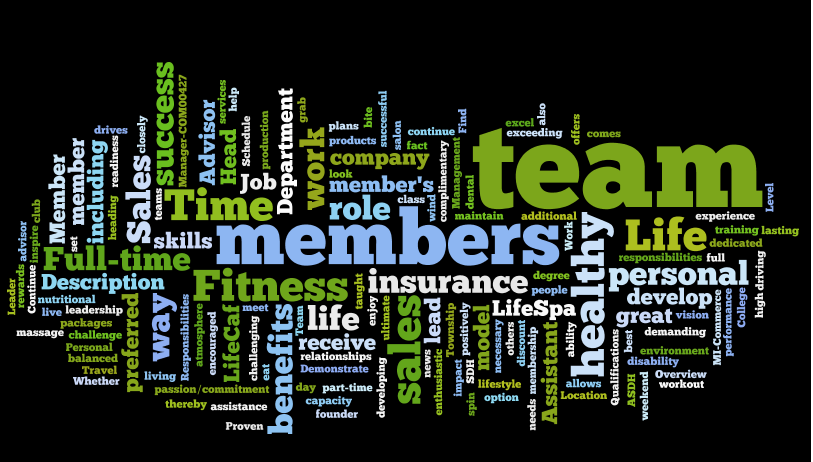
For example, a job description for a sales manager position for a fitness company includes the following keywords (among others):

  • Personal sales,
  • Model for team members,
  • Weekend production,
  • Sales Department Head,
  • Sales team,
  • College degree,
  • Member adviser

One way to be sure you are targeting keywords is to highlight all of the keywords in a variety of similar job descriptions and then incorporate all of them into your resume. Include acronyms (for example IT) as well as complete words (information technology). You should probably have at least 25 targeted keywords or phrases included in your resume.

Some fun tools I suggested during the webinar to help you visualize your keywords are Wordle — (http://www.wordle.net/) and Tag Crowd (http://tagcrowd.com). The picture accompanying this post is a Wordle representation of that sales manager position description.

You can see in the Wordle that words such as team, success, sales, benefit and healthy are highlighted. (Yes, I know that healthy is an adjective!) That would suggest those words should appear (among the others) in your resume. The bigger the word appears in the word cloud, the more significant Wordle considers it. Consider creating a word cloud of your job descriptions and comparing it to one of your resume. It’s not scientific, but it does offer a visual way to identify if you are including the details you need to land the job.

Filed Under: Career Advice, Resume Advice Tagged With: career coach, how to look for a job, keppie careers, keywords for job search, Miriam Salpeter, Resume Advice

Are you a French fry or a job seeker?

November 21, 2010 By Miriam Salpeter

One of the first things I tell prospective clients who have received job hunting  advice elsewhere before coming to me is that a lot of job search is unscientific — what one person likes, another thinks is useless. A good example is the cover letter debate. Some recruiters expect a cover letter, others believe they are a waste of time. The fact that opinions vary about “right and wrong” is clear in resume-ology as well. The fact is, there is no absolute right way. There are best practices, and the rest is up to the job seeker or resume writer.

So, when I was speaking to a prospective client who told me he had been to a LinkedIn workshop and had his resume reviewed, I asked him to share a bit about what he had already learned, as I never want to confuse a job seeker from the get go with contradicting information.

Then, he told me that someone had advised him to suggest he was a “seasoned” professional in the headline of his resume. That’s when my coaching self control hit a road bump and I knew I needed to explain why he should not say he was “seasoned.”

I asked, “Are you a French fry?” (Actually, I didn’t really ask that. But, our discussion did hone in on that question.) Think about it: what is the chance that anyone has included the word seasoned in his or her applicant tracking system software (that scans resumes and helps identify the best ones) as a “grab this person if you find him” word? I’m thinking not very many.

I explained to the prospective client that it is so important to choose each word on the resume based on 1) the fact that it describes you (the job seeker) and clearly outlines what you have to offer (your skills and accomplishments – as they relate to the employer’s needs) and 2) the chance that the employer has flagged that keyword as important for the job.

Think about this when you get advice about your resume. Don’t just blindly incorporate information or words because someone mentioned them — think about what those words will be doing to help you get where you want to go.

Stay tuned for more advice about writing targeted job search materials!

photo by Gudlyf

Filed Under: Career Advice, Resume Advice Tagged With: career coach, coach, how to find a job, keppie careers, Miriam Salpeter, Resume Advice

How to access the hidden job market

November 16, 2010 By Miriam Salpeter

I’m fortunate to live in the Atlanta area, where there is an active and talented, social media savvy recruiter community. I’m lucky to be able to meet these recruiters “in real life,” or as my friend Phyllis Mufson says, “in 3D.” One such recruiter is Jim Stroud. Jim is well known in the field for his work as a “Searchologist” (someone adept at online research), with an expertise in the full life-cycle placement of Executive and Technical personnel, Recruitment Research and Competitive Intelligence. What does all that mean? He has a lot of ideas about how to teach job seekers about how recruiters think.

While not everyone is going to find a job via a recruiter, I think his video about how to access the hidden job market is worth every job seeker’s time. This is what he says about the video:

Did you know that traditional job searches leave you at a disadvantage? Why? Simply put, there are a lot of unadvertised jobs that you are overlooking everyday. If you do not know about these hidden jobs. its because you have been looking in the wrong places. Its time to do something different! In this video on job search strategy, Jim Stroud gives tips on how to prospect the hidden job market. Tune in now and PLEASE share with other job seekers in your network.

Jim asked me to share this, so here it is. Let me know what you think, and be sure to be in touch if you’d like help implementing Jim’s suggestions. If you are ready for a social resume that gets results (and is optimized for search), contact me!

How To Find Hidden Jobs from Jim Stroud on Vimeo.

Filed Under: Career Advice, Networking, Resume Advice Tagged With: hidden job market, how to be found online, how to find a job, Jim Stroud, keppie careers, Miriam Salpeter

  • « Go to Previous Page
  • Page 1
  • Interim pages omitted …
  • Page 4
  • Page 5
  • Page 6
  • Page 7
  • Page 8
  • Interim pages omitted …
  • Page 15
  • Go to Next Page »

Follow Us!

  • Facebook
  • Instagram
  • LinkedIn
  • Pinterest
  • Twitter

Be an Insider: Sign Up to Receive Special Offers & Free Gift


About Keppie Careers

Are you a job seeker or business owner? You’ve come to the right place!
Click here to find out more.

Contact Us

Have a question or comment?
Click here to Contact Us.
© Copyright 2024 Keppie Careers