
• Skip to primary navigation
  • Skip to main content
  • Skip to footer

Keppie Careers

Social media speaker, social media consultant, job search coach

  • About
    • Expert Job Search and Social Media Consultant / Speaker
  • Services
    • For Job Seekers
    • For Entrepreneurs
    • Social Media Coaching and Consulting
    • Speaking/Keynotes
  • Resources
    • Sample Resumes
    • Quoted In
  • Books
  • Blog
  • Contact

Feeling stuck in your job search?

December 1, 2010 By Miriam Salpeter

I want to thank my friend Jane Pollak for sharing a funny video that illustrates how I think a lot of job seekers feel today – stuck! However, as the video demonstrates, sometimes, feeling stuck is really just that – a feeling. Looking for a job can be frustrating, but there is a lot that you do control. You really do drive your own career bus.

I hope this video makes you chuckle, but if you are feeling stuck, I hope it also helps you recognize that you CAN start to put one foot in front of the other and get your job search strategy moving!

If you need some help to get started, that’s my specialty! Need a resume transformation? A social resume? An online presence? Some guidance about what to do next, or how to get started? Contact me for information.

(Excuse the ad. I couldn’t resist posting this, though.)

photo by xJasonRogersx
Filed Under: Career Advice Tagged With: career coach, Jane Pollak, job search, keppie careers, Miriam Salpeter, what to do if you are stuck

How to incorporate keywords in your job search materials

November 23, 2010 By Miriam Salpeter

Well-informed job seekers know that companies typically screen resumes using software that searches for key words. That’s why your resume should be targeted/personalized for each job. Re-writing even a section  of your resume can help scanning software (or Applicant Tracking Systems) mark your resume as one to review further.

I recently presented a webinar for The Career Summit about how to build a bridge to your next employer, and keywords (how to find them and how to USE them) play a huge role in paving the way to a new employer.

It is crucial for job seekers to identify the words that employers are using to look for them and to use those in their resumes, LinkedIn profiles, Twitter bios and Facebook bio.

You don’t want to waste any words on your resume. Earlier this week, I asked, “are you a job seeker or a French fry?,” making the point that job seekers need to select words carefully to be sure they make sense and will attract employers.

The best place to find keywords that are most relevant for your targeted organization is in job descriptions. Study job descriptions on job boards, via LinkedIn and any place that employers advertise opportunities. The descriptions don’t need to be for jobs you’d actually apply to do. For example, maybe the job is in Omaha, and you plan to stay in Miami. If the description itself is relevant to what you want to do, that information can be useful to inform your materials.

Review job descriptions and identify the nouns and noun phrases. (Remember from grade school — a noun is a person, place or thing.) Focus on being as specific as possible. For example, assistant (a noun) is not as specific as administrative assistant, or executive administrative assistant (noun phrases). Technical skills (including software), degrees and other specifics related to the job may all be keywords.

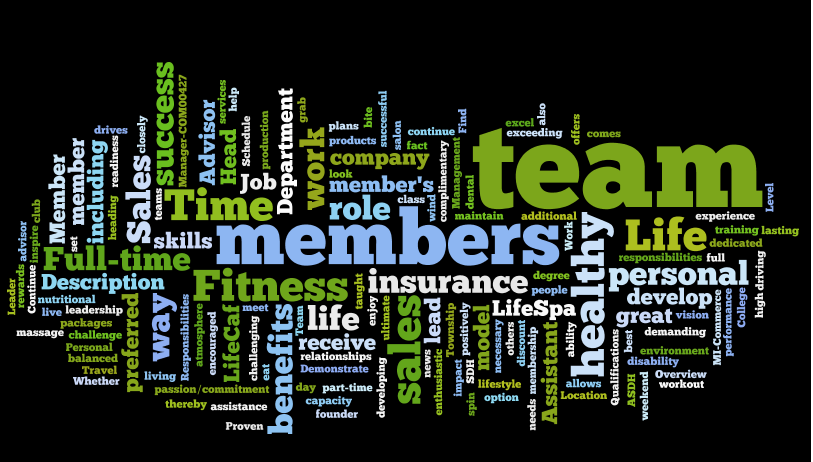
For example, a job description for a sales manager position for a fitness company includes the following keywords (among others):

  • Personal sales,
  • Model for team members,
  • Weekend production,
  • Sales Department Head,
  • Sales team,
  • College degree,
  • Member adviser

One way to be sure you are targeting keywords is to highlight all of the keywords in a variety of similar job descriptions and then incorporate all of them into your resume. Include acronyms (for example IT) as well as complete words (information technology). You should probably have at least 25 targeted keywords or phrases included in your resume.

Some fun tools I suggested during the webinar to help you visualize your keywords are Wordle — (http://www.wordle.net/) and Tag Crowd (http://tagcrowd.com). The picture accompanying this post is a Wordle representation of that sales manager position description.

You can see in the Wordle that words such as team, success, sales, benefit and healthy are highlighted. (Yes, I know that healthy is an adjective!) That would suggest those words should appear (among the others) in your resume. The bigger the word appears in the word cloud, the more significant Wordle considers it. Consider creating a word cloud of your job descriptions and comparing it to one of your resume. It’s not scientific, but it does offer a visual way to identify if you are including the details you need to land the job.

Filed Under: Career Advice, Resume Advice Tagged With: career coach, how to look for a job, keppie careers, keywords for job search, Miriam Salpeter, Resume Advice

Are you a French fry or a job seeker?

November 21, 2010 By Miriam Salpeter

One of the first things I tell prospective clients who have received job hunting  advice elsewhere before coming to me is that a lot of job search is unscientific — what one person likes, another thinks is useless. A good example is the cover letter debate. Some recruiters expect a cover letter, others believe they are a waste of time. The fact that opinions vary about “right and wrong” is clear in resume-ology as well. The fact is, there is no absolute right way. There are best practices, and the rest is up to the job seeker or resume writer.

So, when I was speaking to a prospective client who told me he had been to a LinkedIn workshop and had his resume reviewed, I asked him to share a bit about what he had already learned, as I never want to confuse a job seeker from the get go with contradicting information.

Then, he told me that someone had advised him to suggest he was a “seasoned” professional in the headline of his resume. That’s when my coaching self control hit a road bump and I knew I needed to explain why he should not say he was “seasoned.”

I asked, “Are you a French fry?” (Actually, I didn’t really ask that. But, our discussion did hone in on that question.) Think about it: what is the chance that anyone has included the word seasoned in his or her applicant tracking system software (that scans resumes and helps identify the best ones) as a “grab this person if you find him” word? I’m thinking not very many.

I explained to the prospective client that it is so important to choose each word on the resume based on 1) the fact that it describes you (the job seeker) and clearly outlines what you have to offer (your skills and accomplishments – as they relate to the employer’s needs) and 2) the chance that the employer has flagged that keyword as important for the job.

Think about this when you get advice about your resume. Don’t just blindly incorporate information or words because someone mentioned them — think about what those words will be doing to help you get where you want to go.

Stay tuned for more advice about writing targeted job search materials!

photo by Gudlyf

Filed Under: Career Advice, Resume Advice Tagged With: career coach, coach, how to find a job, keppie careers, Miriam Salpeter, Resume Advice

What business owners and job seekers have in common

November 9, 2010 By Miriam Salpeter

It was exciting to attend Social Media for Start ups, a panel that is part of Social Media Atlanta’s events this week. The experts provided lots of great advice that is relevant for those planning to start businesses, but also for anyone seeking a job.

The panel was moderated by Laura Nolte, Principal – Green Theory. Panelists were:

Adam Rice, Co-Founder – Looxii

Jeremy Porter, Founder – Journalistics

Lance Weatherby, Startup Catalyst – ATDC at Georgia Tech

Nicole Jayne, Social Media Manager – Scoutmob

Sarah DeVries, BlinqMedia

Some takeaways:

Lance made a point about “social proof,” a term that means you show, rather than tell, what you have to offer. Someone who demonstrates a social proof may be applying for a job in social media and do so by using social media in a particularly unique or clever way. The concept of social proof is key for entrepreneurs and start up businesses — they need to show what they can get done. It is also important for job seekers. Always be thinking about how to PROVE that you have the skills, experience and expertise you say you have. Think, “show, don’t tell.”

Adam and Jeremy suggested staying flexible and focusing on what customers want…Another crossover here between a start up and a job seeker. While I advocate job seekers target organizations and opportunities, sometimes, it is necessary to make adjustments in job search strategies. Be prepared to adjust if you want to succeed. For job seekers, the “customer” is the hiring manager. Focus on what he or she wants. Be that person (assuming you are!)

Jeremy suggested that start ups focus on building communities via social media (via blogs and using Twitter)  in the pre-launch phase. He noted that the product could be great, but that the community adds value. Sarah added that word of mouth is key for start ups and suggested relying on friends (and, by extension – social media friends) for buzz. Again — a perfect analogy for job seekers. Build your network before you need it. (Before you are job hunting.) You may be amazing, but it doesn’t matter if no one knows about you. Create a community (or more than one) and rely on it when you are in job search mode.

Jacqui Chew, principal of iFusion Marketing, provided several great insights from the audience. She pointed out that to gain credibility, you need to create your own content and become a go-to resource for your niche. She reminded the audience to provide value by building an audience. Perfect advice for job seekers as well as start ups!

Sarah suggested start ups avoid long, drawn out campaigns because they cause reader fatigue. If you see the same ad on Facebook for a month, you will probably ignore it at some point, right? The same goes for job seekers. Don’t be the “job seeker” who does nothing but look for a job, talk about looking for a job and asking people if they “know anyone.” Instead – remember the previous point – think about how you can provide value and gain credibility. How can you connect for content?

Jeremy commented that start ups need to balance “push ideas” with “pull ideas.” This is absolutely crucial for job seekers as well. You cannot rely on finding a job by sending out resumes and applications. Think about how you can attract people to you. (See “create content.”)

Think about how you can incorporate these ideas into your job search. Can you do anything differently that may achieve a better result?

Filed Under: Career Advice, social media Tagged With: Adam Rice, BlinqMedia, business owner, career coach, Green Theory, how to get a job, iFusion Marketing, Jacqui Chew, Jeremy Porter, job search, Journalistics, keppie careers, Lance Weatherby, Laura Nolte, Looxii, Miriam Salpeter, Nicole Jayne, Sarah DeVries, Scoutmob, Social Media Atlanta

Tips for effective networking

November 3, 2010 By Miriam Salpeter

Today, I am delighted to share a guest post by Alexandra Levit, courtesy of JobSTART101.org.

JobSTART101 is a first-of-its-kind course that’s free and available to college students and recent graduates nationwide. Alexandra, whose blog is Water Cooler Wisdom, is an author and speaker on business and workplace issues. She is also host of JobSTART101.

The purpose of professional networking is to gain information, increase your visibility in your field, and establish personal connections that will help you advance in your career. No matter how much you love your job, you should always be looking for ways to expand your networks because, ideally, your contacts will follow you from position to position. A strong network allows you to get advice from trusted sources, to keep your professional knowledge current, to find career opportunities, and to support the careers of others. Young professionals who are willing to ask for help will find it easier to navigate within their organization and perform their job duties. Your network can be an excellent source of information when you have a question that you do not want to ask your co-workers or supervisor.

Your network should have lots of variety; individuals from different companies, career levels, and professions can add a range of perspectives. Keeping in touch with your college friends who might be in different companies and industries is a great way to populate your network. Joining a professional association in your field and regularly attending its events is also a smart idea. Finally, investigate your company’s sponsored programs; many organizations provide opportunities for individuals to network within the company. Training events, visits from management, guest speakers, or various types of interest-based events can yield the same type of contacts as an external event.

Know that it takes time to authentically populate your network. But also know that each new contact is a step in the right direction. When I first got into educating people on twenty-something workplace issues, it was startling how helpful I found just one meeting of the Chicago chapter of the American Society for Training and Development. I walked out of the event with business cards for several potential clients and mentors. My network increased after only one event.

Before going to such an event, think about what you hope to get out of attending. Is it general knowledge? Is it a new contact in your field? Or perhaps you are looking for someone to provide input on one of your projects? Understand who the speakers will be at the event and how you might contact them or access their materials in advance of or after the event. Also, learn what other companies and individuals might be at the event. Prepare a few questions that you want to explore, and set a goal to answer them at the event. For example, if you want to do an informational interview—a thirty-minute conversation with an expert on a new development in your field—your goal may be to find someone at the event with that type of expertise. Think about how you would propose a call with that individual, or if this person is local, perhaps a face-to-face meeting might make more sense.

Many experts are willing to speak and share their knowledge, but some may not be as willing. Don’t become discouraged. It may take a few attempts at building your network to make a personal connection. Once you have received an initial response and are moving forward with an interaction—whether it’s in person or via e-mail or phone—be friendly, respectful, and conscious of the contact’s time constraints. Confirm your contact’s available time and the topic you want to cover. If you have the opportunity to sit down with a contact in person, remember to make eye contact, smile, shake hands firmly, and exchange business cards. Ask thoughtful questions and listen carefully to the answers.

If you are meeting over coffee or a meal, when the check comes, simply say to your contact, “I invited you here today, so this is my treat.” This, combined with a handwritten thank-you note, will make the best possible impression and leave the door open for future follow-up—which you should do, of course! If your contact gave you any advice or suggested a course of action, touch base every few months with an update on your progress. And since effective networking always involves give and take, think about ways you can help your contact in return.

JobSTART 101 is a free, online 90 minute course dedicated to helping college students and recent grads master skills critical to workplace success. Check it out at www.jobstart101.org.

photo by Nimages DR

Filed Under: Networking, Uncategorized Tagged With: Alexandra Levit, career coach, how to find a job, JobSTART101, keppie careers, Miriam Salpeter, Networking

  • « Go to Previous Page
  • Page 1
  • Interim pages omitted …
  • Page 13
  • Page 14
  • Page 15
  • Page 16
  • Page 17
  • Interim pages omitted …
  • Page 53
  • Go to Next Page »

Follow Us!

  • Facebook
  • Instagram
  • LinkedIn
  • Pinterest
  • Twitter

Be an Insider: Sign Up to Receive Special Offers & Free Gift


About Keppie Careers

Are you a job seeker or business owner? You’ve come to the right place!
Click here to find out more.

Contact Us

Have a question or comment?
Click here to Contact Us.
© Copyright 2024 Keppie Careers