• Skip to primary navigation
  • Skip to main content
  • Skip to footer

Keppie Careers

Social media speaker, social media consultant, job search coach

  • About
    • Expert Job Search and Social Media Consultant / Speaker
  • Services
    • For Job Seekers
    • For Entrepreneurs
    • Social Media Coaching and Consulting
    • Speaking/Keynotes
  • Resources
    • Sample Resumes
    • Quoted In
  • Books
  • Blog
  • Contact

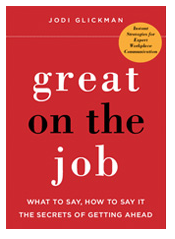
How to be “Great on the Job,” a review

May 23, 2011 By Miriam Salpeter

Communication — and communicating well, in business and in all circumstances — is key for career success. It’s not always easy to know what to say, and it certainly isn’t always obvious how to say it. Jodi Glickman’s new book, Great On the Job, comes to the rescue. Known as a strong, strategic communicator with many successful examples to back up her words, Jodi, who’s landed jobs due to her interviewing skills, even though she’s been told she was the “least qualified” of all the candidates, outlines how to communicate well for professional success.

Jodi teaches readers how to re-think the basics. (When’s the last time you re-evaluated how you introduce yourself on a phone call? Do you ask the person if it is a good time to talk?) to more advanced communication skills, including how to manage in a crisis, communicate about a missed deadline or how to recover when you aren’t prepared for a presentation).

She focuses on four concepts:

Generosity – thinking about the other person before you consider your own needs and focusing on how to make that person’s life better.

Initiative – being proactive without creating work for others, thus moving your career forward by “engaging in meaningful and productive work that contributes to the greater good” (p. xxiii).

Forward Momentum – creating, nurturing and sustaining personal relationships, even when you have no specific “reason” in mind, other than to just keep in touch.

Transparency – being honest when you mess something up and admitting when you don’t know something.

In easy-to-follow case studies, she describes scenarios and outlines exactly how to respond in each situation.

As a bonus, the book includes details about how to sell yourself. I loved the section, “Different Person, Different Pitch,” where Jodi outlines how important it is to identify which of your stories will resonate with your audience members. She explains, “Just as you probably have multiple online profiles — Facebook, Linkedin, Twitter — you should also understand that different situations warrant different pitches of stories.” She walks you through how to focus on determining what elements of your story to develop and use later.

To top it off, there’s a “cheat sheet” section at the end, outlining advice from each of the sections and reminding the reader of the salient points in each chapter. What a great resource for anyone reading the book and a way to be sure it’s easy to implement Jodi’s advice!

I highly recommend picking up a copy of Great on the Job to learn “what to say, how to say it — the secrets of getting ahead.”

Visit Jodi’s site to learn how to purchase a copy from your favorite bookseller.

Filed Under: Career Books, Communicating Tagged With: communicating at work, Great on the Job, how to communicate well, how to find a job, how to get a promotion, Jodi Glickman, keppie careers, Miriam Salpeter

Telephone etiquette for your job search

April 8, 2011 By Miriam Salpeter

Years ago, when I was working on Wall Street (and mobile phones were a lot less common), I called a candidate for a job. She answered her cell phone — from a loud, New York City street corner. You can imagine our conversation:

Me: We’d like to see about scheduling an interview…

Her: I’m sorry…I can’t really hear you so well. It’s really LOUD here. Let me try to get somewhere quieter.

Me: Okay. (Waiting…thinking — why did she answer the phone if she can’t hear me?)

Her: Okay – I think this is better…

Me: We’d like to have you come in for an interview. When is a good time?

Her: Oh, this isn’t any better. Can I call you back?

Me: (Thinking…It hardly matters what I say — she can’t hear me.) Okay. Bye.

While it was great to b able to reach this candidate (in theory) while she was out and about — a communication revolution at the time — the reality was she would have been better of letting me leave a message and calling me back when she was in a quiet place.

That was probably 15 years ago. Unfortunately, it doesn’t seem as if we’ve learned much about telephone etiquette in the interim. Just yesterday, I contacted a job seeker via a mobile number. He answered, and we proceeded with pretty much exactly the same conversation as above. While I am not hiring anyone, I imagine if I were, it would have been pretty much the same story.

It’s not rocket science – potential employers and everyone else will judge you based on anything you offer them. If you can’t hear to speak on the phone, don’t answer the phone!

Once your resume is out there, be aware that any time the phone rings, it might be your dream job on the line. If you’re in a bad or loud spot – let it go to voice mail (to your nice, clear, professional greeting), listen to the message and call back as soon as possible.

While providing a mobile number for your job search should prevent anyone else answering the phone, resist the need to answer your phone whenever it rings – even when we are driving or in the middle of a mob of screaming baseball fans. If you are job hunting, be aware that trying to scream, “I can’t HEAR you” or cursing the driver who just cut you off as you are picking up your phone does not offer the impression you want to give your prospective employer.

You (and the caller) will be glad you did.

photo by woodleywonderworks

Filed Under: Communicating, Job Stories

Celebrating Kindness Day – How to help a job seeker

April 3, 2011 By Miriam Salpeter

Today, my colleague Phyllis Mufson invited me to participate in “Kindness Day.” Via her blog, she suggests perpetrating kindness via Twitter by doing and tweeting acts of kindness, using the hashtag (search tag) #Kindness.

Writing about job search and interacting regularly with job seekers, I thought it made sense to also contribute a brief blog with tips about how to be kind to job seekers. It’s very easy to make half-hearted offers to help someone in the midst of a job search. Everyone has made one of these offers in one way or another: “Let me know what I can do to help.” Or, “I’m happy to help, just let me know what you need.”

It’s easy to say, but unlikely to encourage the job seeker to follow through. We all know it’s difficult to ask for help — job seekers are no more likely to follow up with your offer than someone with a broken leg you tell to “let me know what I can do.” We’re all self-sufficient and don’t like to accept assistance.

What’s a better suggestion, in honor of Celebrating Kindness Day? Just do something nice! Here are some suggestions that came to mind.

  • Invite a job seeking friend to meet for coffee with a contact who might be able to help him or her connect with a company of interest.
  • Ask the job seeker what companies interest him or her. Review your own network; if there is a good contact, invite both to meet for lunch and facilitate an in-person introduction.
  • If you’re attending an event that could be useful for your job seeking friend, invite him or her to go with you and make a point facilitate targeted introductions.
  • If you’re a close friend, offer to do something nice personally — offer to babysit, so the job seeker can have some time alone – for job hunting activities or just to relax.
  • Keep an eye out for useful information that could assist the job seeker, and pass it along. If you hear of well-suited opportunities, offer to forward a resume and actually make an effort to connect the job seeker with the opportunity.
  • Peruse your own social networks — your LinkedIn, Twitter and Facebook connections — for possible good contacts for the job seeker. Do everything you can to facilitate their connection.
  • Keep an eye open via your own networks about resources such as Hiring for Hope/Job Angels — where volunteers offer to assist job seekers.

What other ideas do you have? What have you done to help a job seeker? If you ARE a job seeker, what’s the best thing someone could do for you? Also share tips of what is NOT kind — or not helpful — for job seekers.

Thanks to this group of Twitter users for co-hosting Celebrating #Kindness Day! Be sure to follow them and tweet some kindness today with the #Kindness hashtag!

Kim Wells @kwells2416 http://Twitter.com/kwells2416
Susan Smith @togetherwf http://Twitter.com/togetherwf
Dave Carpenter @Dave_Carpenter http://Twitter.com/Dave_Carpenter
Sarah Hodsdon @Sarahndipitous http://Twitter.com/Sarahndipitous
Georgia Feiste @feistycoach http://Twitter.com/feistycoach
Jacob Share @jacobshare http://Twitter.com/jacobshare
Melissa Cooley @TheJobQuest http://Twitter.com/TheJobQuest
Phyllis Mufson @PhyllisMufson http://twitter.com/phyllismufson

photo by the_moment

Filed Under: Communicating, Job Stories Tagged With: career coach, help a job seeker, Hiring for Hope, how to help a job seeker, keppie careers, Miriam Salpeter, social media

Simply Hired reports opportunities up for job seekers

March 11, 2011 By Miriam Salpeter

In Simply Hired’s February Jobs Report, there were some silver linings for job seekers.

They reported growth in 17 of 18 industries; only Technology was down a bit (-2.0%). Reported large growth areas: Military (22.7%), Travel (20.9%) and Agriculture (20.0%)

Month-over-month, growth in job openings (based on posted jobs on Simply Hired) were up 3.8% and year-over-year (compared to February 2010), they were up 49.7%.

There are (statistically) 4 people for every 1 job opening nationwide. Top hiring companies nationwide included:

  • Home Depot
  • HCA
  • Securus
  • Starbucks
  • U.S. Air Force

Top hiring sectors based on jobs listed on Simply Hired included: agriculture, automotive, construction, education, financial services, government, health care, hospitality and legal.

Statistically, the most competitive place to land a job was Miami and Fort Lauderdale, where there are 9 candidates for every one opening. Washington D.C. has one job for every one candidate. (Remember, this is a statistical analysis, which doesn’t necessarily mean you will or will not be able to land an opportunity.)

Daniel Greenberg, CMO, SimplyHired.com, explains how they calculate these ratios and what they mean for job seekers:

SimplyHired.com’s unemployment ratio is calculated by taking the average of the total number of currently unemployed persons in the U.S. (as reported by the Bureau of Labor Statistics) over the total number of job openings listed on SimplyHired.com each month. In February, the unemployment ratio was 4:1 nationally. This means that on average there were four job seekers for every one job opening. What this means for job seekers varies by location, if you’re looking for a job in an area like Miami, the unemployment ratio is actually 9:1, and in Washington, DC the unemployment ratio is an ideal 1:1.

This ratio also includes every job opening, meaning that part-time and contract work is considered – not just full-time jobs. Everything else being equal, job seekers in highly competitive job markets would be well served to relocate to areas that have more favorable job seeker-to-unemployment ratios.”

—

If you’re looking for a job — or thinking you need to start using social media to propel your career, my book: Social Networking for Career Success is available on Amazon (at a great discount). Please order now!


photo by Redvers

Filed Under: Communicating, Cover Letters, Job Hunting Tools, Job Stories Tagged With: career coach, Daniel Greenberg, how to find a job, jobs data, keppie careers, Miriam Salpeter, Simply Hired, social media

Keep upbeat to improve your chances of landing a job: here’s how

December 20, 2010 By Miriam Salpeter

I recently noticed some of my friends on Facebook taking advantage of apps such as “my year in status” that analyze their status updates and list out their top-used words. If you use Facebook, no doubt you’ve seen this, too. How would your updates look? We all have friends who seem to post about their every headache and punctuate every status update with “UGH” and similar exclamations that tend to be negative. Then, there are those whose posts stand out because they are always positive – and hopeful – even when facing really tough circumstances, including illness and joblessness.

Think about it. Are you more likely to want to hire Debbie Downer or Sally Sunshine?

Clearly, it is easy to feel discouraged and hopeless if you are in the midst of an unsuccessful job hunt.

Eve Tahmincioglu recently wrote about the issue of hopelessness in her MSNBC column:

The nation’s jobless rate has been hovering near 10 percent for many months now, but one of the most disturbing statistics is that as of October, 6.2 million, or four in 10 unemployed Americans, had been out of work for 27 weeks or more. That’s the highest number on record, according to the Bureau of Labor Statistics.

However, keep in mind, as Eve notes in her post: “Feeling hopeless — and appearing hopeless to others — can actually keep you from landing a job, according to Savitri Dixon-Saxon, associate dean of the School of Counseling and Social Service at Walden University.”

A study led by Ron Kaniel of Duke and reported in MIT Sloan Management Review found that “Optimists fared better than their less-optimistic peers in some important ways…For one thing, the optimistically inclined MBA students found comparable jobs to their peers — but found them more easily, with less-intensive job searches.  Even better, two years after graduation the optimists were more likely than their less-optimistic peers to have been promoted.” (Hat tip: Maggie Mistal.)

Sandra Naiman, author of The High Achiever’s Secret Codebook: The Unwritten Rules for Success at Work, points out that while this certainly is a challenging time, there are steps that can help people stay upbeat. “The key is to engage in activities that provide self-satisfaction and build self esteem,” she says. She offers the following suggestions:

  • Engage in activities that make you feel good about yourself.
  • Achieve tangible results. It can be as simple as cleaning out a closet, organizing the garage or waxing the car. It can also be related to volunteer or family activities, such as writing a neighborhood watch newsletter or making cookies with the kids. Make sure, that at the end of each day, you can point to something you accomplished.
  • Surround yourself with positive, supportive people. Avoid the people who always see the glass as half empty or those who drain your energy.
  • Keep promises to yourself.
  • Reward yourself. Children aren’t the only ones who need a “gold star” at the end of the day.
  • Follow a healthy routine. Eat well, exercise and take good care of your body.
  • Allow yourself some down time. You can’t be up and optimistic all the time, so give yourself permission to have a bad day. If you diligently follow the above suggestions, you can count on tomorrow to be better.

Read more suggestions:

Stay positive and upbeat while job hunting

You control your job hunting destiny

It might be easier to stay positive if you have a coach in your corner! Need help getting your job search jump started? Not sure you can put all of the great tools at your disposal to good use? Need a great resume? Learn how I can help you propel your job hunt forward.

photo by Proggie

Filed Under: Career Advice, Career/Life Balance, Communicating Tagged With: Eve Tahmincioglu, how to find a job, Jist, keppie careers, Maggie Mistal, Miriam Salpeter, my year in status, optimism in job hunting, Sandra Naiman, Savitri Dixon-Saxon, The High Achiever's Secret Codebook, why to be optimistic in a job hunt

  • « Go to Previous Page
  • Page 1
  • Page 2
  • Page 3

Follow Us!

  • Facebook
  • Instagram
  • LinkedIn
  • Pinterest
  • Twitter

Be an Insider: Sign Up to Receive Special Offers & Free Gift


About Keppie Careers

Are you a job seeker or business owner? You’ve come to the right place!
Click here to find out more.

Contact Us

Have a question or comment?
Click here to Contact Us.
© Copyright 2024 Keppie Careers