• Skip to primary navigation
  • Skip to main content
  • Skip to footer

Keppie Careers

Social media speaker, social media consultant, job search coach

  • About
    • Expert Job Search and Social Media Consultant / Speaker
  • Services
    • For Job Seekers
    • For Entrepreneurs
    • Social Media Coaching and Consulting
    • Speaking/Keynotes
  • Resources
    • Sample Resumes
    • Quoted In
  • Books
  • Blog
  • Contact

Keep upbeat to improve your chances of landing a job: here’s how

December 20, 2010 By Miriam Salpeter

I recently noticed some of my friends on Facebook taking advantage of apps such as “my year in status” that analyze their status updates and list out their top-used words. If you use Facebook, no doubt you’ve seen this, too. How would your updates look? We all have friends who seem to post about their every headache and punctuate every status update with “UGH” and similar exclamations that tend to be negative. Then, there are those whose posts stand out because they are always positive – and hopeful – even when facing really tough circumstances, including illness and joblessness.

Think about it. Are you more likely to want to hire Debbie Downer or Sally Sunshine?

Clearly, it is easy to feel discouraged and hopeless if you are in the midst of an unsuccessful job hunt.

Eve Tahmincioglu recently wrote about the issue of hopelessness in her MSNBC column:

The nation’s jobless rate has been hovering near 10 percent for many months now, but one of the most disturbing statistics is that as of October, 6.2 million, or four in 10 unemployed Americans, had been out of work for 27 weeks or more. That’s the highest number on record, according to the Bureau of Labor Statistics.

However, keep in mind, as Eve notes in her post: “Feeling hopeless — and appearing hopeless to others — can actually keep you from landing a job, according to Savitri Dixon-Saxon, associate dean of the School of Counseling and Social Service at Walden University.”

A study led by Ron Kaniel of Duke and reported in MIT Sloan Management Review found that “Optimists fared better than their less-optimistic peers in some important ways…For one thing, the optimistically inclined MBA students found comparable jobs to their peers — but found them more easily, with less-intensive job searches.  Even better, two years after graduation the optimists were more likely than their less-optimistic peers to have been promoted.” (Hat tip: Maggie Mistal.)

Sandra Naiman, author of The High Achiever’s Secret Codebook: The Unwritten Rules for Success at Work, points out that while this certainly is a challenging time, there are steps that can help people stay upbeat. “The key is to engage in activities that provide self-satisfaction and build self esteem,” she says. She offers the following suggestions:

  • Engage in activities that make you feel good about yourself.
  • Achieve tangible results. It can be as simple as cleaning out a closet, organizing the garage or waxing the car. It can also be related to volunteer or family activities, such as writing a neighborhood watch newsletter or making cookies with the kids. Make sure, that at the end of each day, you can point to something you accomplished.
  • Surround yourself with positive, supportive people. Avoid the people who always see the glass as half empty or those who drain your energy.
  • Keep promises to yourself.
  • Reward yourself. Children aren’t the only ones who need a “gold star” at the end of the day.
  • Follow a healthy routine. Eat well, exercise and take good care of your body.
  • Allow yourself some down time. You can’t be up and optimistic all the time, so give yourself permission to have a bad day. If you diligently follow the above suggestions, you can count on tomorrow to be better.

Read more suggestions:

Stay positive and upbeat while job hunting

You control your job hunting destiny

It might be easier to stay positive if you have a coach in your corner! Need help getting your job search jump started? Not sure you can put all of the great tools at your disposal to good use? Need a great resume? Learn how I can help you propel your job hunt forward.

photo by Proggie

Filed Under: Career Advice, Career/Life Balance, Communicating Tagged With: Eve Tahmincioglu, how to find a job, Jist, keppie careers, Maggie Mistal, Miriam Salpeter, my year in status, optimism in job hunting, Sandra Naiman, Savitri Dixon-Saxon, The High Achiever's Secret Codebook, why to be optimistic in a job hunt

Important LinkedIn change impacts job seekers

December 10, 2010 By Miriam Salpeter

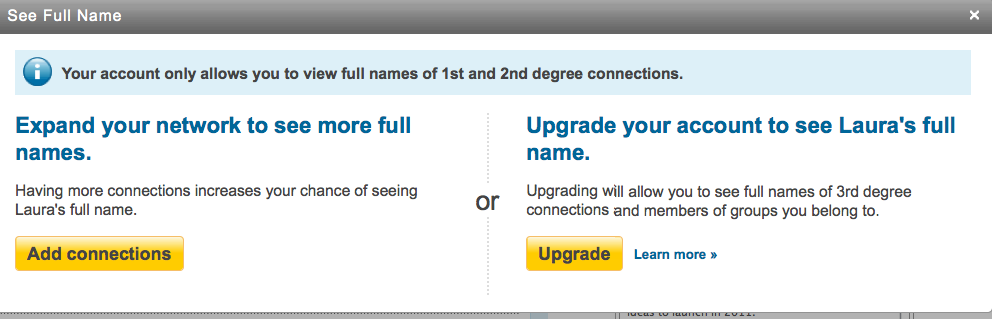
Watching changes in social networking platforms and keeping up-to-date on their ever-changing tools can be a full-time job. My colleague, Jason Alba, author of I’m On LinkedIn, Now What?, posted yesterday about a new development in LinkedIn search that is important for job seekers. He explains that when a non-paying LinkedIn user reviews a third-degree connection’s profile, LinkedIn does not share that person’s name in the headline. (It lists the first name and last initial — see photo below/right). 

It then prompts the user with two choices:

1. To expand your network to enhance your opportunity to connect with the user at a second-degree level. (This would be free, but takes effort.)

2. To upgrade to a paid account that will allow the person to easily find full names for third-degree contacts

This is an interesting development, and Jason notes that it probably is a precursor for other, similar moves by LinkedIn to withhold information and potentially encourage more people to become paid members.

However, at this point, LinkedIn really does not have the upper hand in preventing people from identifying full contact information or names of those whose last names it may withhold. I can (at this point) still see the entire actual profile of my third-degree connections (sans last name in the headline). Any information they share in their profiles (including listing an email address or full name in their profile or Summary section, their personal websites, Twitter accounts, Slideshares, etc.) is still readily available.

My advice to job seekers (and everyone who wants to make it easy — and free) for people to know who you are? Include your full name in your Summary section, link your other professional websites and social networks that have links to your work or work products and consider sharing an email in the context of your Summary.

While it is possible that LinkedIn will become draconian and try to prevent us from sharing this information, or that it will set things up so we cannot easily access other identifying information (such as Twitter account, websites, etc.), that is not the case right now.

Help someone find you by updating your profile. And, consider having your own social resume — a website that you control to share information you want people to know about you. Contact me if you’re interested in owning YourName.com, but could use some help creating a fully operational site that search engines will love and will showcase your best professional information!

Filed Under: social media, Social Networking Tagged With: how to find a job, how to write a LinkedIn profile, Jason Alba, job search, keppie careers, linkedin, Miriam Salpeter

The secret to effective job search

December 1, 2010 By Miriam Salpeter

Today’s post is one of many from members of the Career Collective community I co-coordinate with my colleague Jacqui Barrett-Poindexter. I encourage you to visit other members’ responses, which are linked at the end of my post. Please follow our hashtag on Twitter: #careercollective.

This month’s question focuses on common job search misconceptions. Unfortunately, “confused” is how job seekers often feel. They want to know the “right” way to apply for a job, what exactly their resume should say (and how it should look), whether or not anyone is reading their cover letter (should they even bother sending one?), when (and how often) to follow up…The list goes on and on.

However, I think the most important point that confuses job seekers is that the job search is not really about them. Nor is the resume, application, follow-up notes…None of it is about the job seeker.

The secret to successful job hunting? It’s about the employer.

If you are looking for a job, you need to research organizations and target your materials and networking efforts to appeal to them. You used XY skill at ABC place? That’s great, but what does it have to do with the job you want NOW? Everything on your resume and other communication (social media, in-person networking, etc.) needs to be geared to the employer’s interests and needs. Think of the employer as a spoiled child who wants everything his/her way. Avoid the temper tantrum in this case (which may be YOUR tantrum): give the employer what he needs to see. Convince her that you are the ONE candidate who is qualified and can do the job.

I’ve recently shared information about how to target your resume using keywords. Do that. If you are qualified for the position, you should be able to tweak and target your resume to appeal to your audience and land the interview.

When it comes to your resume, do your research to identify the employer’s salient points. For example, a manager may find that employers need candidates who have the following skills:

  • Mentoring/supervisory skills,
  • Diplomacy/communication
  • Leadership and
  • Specific subject matter expertise.

Once you identify the important skills – write the resume to identify and PROVE you are the candidate with the goods. When someone else reads the resume, will that person see proof of the necessary skills? Does the resume include accomplishments related to each of the points? It is not unusual to see a resume that states something but fails to prove it in the body of the resume. Any point that you are not supporting with evidence in your resume is a lost opportunity to drive home your point to the hiring manager.

Stop focusing on you and your needs – think about what someone else will be thinking when they encounter your materials or meet you. It’s the secret to job hunting successfully: it’s not about you.

Don’t miss my colleagues’ responses to this topic:

  • 5 Misconceptions Entry-Level Job Seekers Make, @heatherhuhman
  • How “Interview Savvy” Are You?, @careersherpa
  • Employers Don’t “Care”, @ValueIntoWords
  • Misconceptions about Using Recruiters, @DebraWheatman
  • 15 Myths and Misconceptions about Job-Hunting, @KatCareerGal
  • Are You Boring HR? @resumeservice
  • Job Search Misconceptions Put Right, @GayleHoward
  • Who Cares About What You Want in a Job? Only YOU!, @KCCareerCoach
  • How to get your resume read (sort of), @barbarasafani
  • The 4 secrets to an effective recruiter relationship, @LaurieBerenson
  • Job Interviews, Chronic Illness and 3 Big Ideas, @WorkWithIllness
  • The secret to effective job search, @Keppie_Careers
  • Superstars Need Not Apply, @WalterAkana
  • The Jobs Under the Mistletoe, @chandlee
  • 8 Common Sense Interview Tips @erinkennedycprw
  • Still no job interview? @MartinBuckland @EliteResumes
  • Misconceptions about the Hiring Process: Your Online Identity is a Critical Part of Getting Hired, @expatcoachmegan

photo by Tambako the Jaguar

Filed Under: Career Advice, Resume Advice Tagged With: Career Advice, career coach, Career Collective, confused job seeeker, how to find a job, job search, keppie careers, Miriam Salpeter, secret to job search

Are you a French fry or a job seeker?

November 21, 2010 By Miriam Salpeter

One of the first things I tell prospective clients who have received job hunting  advice elsewhere before coming to me is that a lot of job search is unscientific — what one person likes, another thinks is useless. A good example is the cover letter debate. Some recruiters expect a cover letter, others believe they are a waste of time. The fact that opinions vary about “right and wrong” is clear in resume-ology as well. The fact is, there is no absolute right way. There are best practices, and the rest is up to the job seeker or resume writer.

So, when I was speaking to a prospective client who told me he had been to a LinkedIn workshop and had his resume reviewed, I asked him to share a bit about what he had already learned, as I never want to confuse a job seeker from the get go with contradicting information.

Then, he told me that someone had advised him to suggest he was a “seasoned” professional in the headline of his resume. That’s when my coaching self control hit a road bump and I knew I needed to explain why he should not say he was “seasoned.”

I asked, “Are you a French fry?” (Actually, I didn’t really ask that. But, our discussion did hone in on that question.) Think about it: what is the chance that anyone has included the word seasoned in his or her applicant tracking system software (that scans resumes and helps identify the best ones) as a “grab this person if you find him” word? I’m thinking not very many.

I explained to the prospective client that it is so important to choose each word on the resume based on 1) the fact that it describes you (the job seeker) and clearly outlines what you have to offer (your skills and accomplishments – as they relate to the employer’s needs) and 2) the chance that the employer has flagged that keyword as important for the job.

Think about this when you get advice about your resume. Don’t just blindly incorporate information or words because someone mentioned them — think about what those words will be doing to help you get where you want to go.

Stay tuned for more advice about writing targeted job search materials!

photo by Gudlyf

Filed Under: Career Advice, Resume Advice Tagged With: career coach, coach, how to find a job, keppie careers, Miriam Salpeter, Resume Advice

How to access the hidden job market

November 16, 2010 By Miriam Salpeter

I’m fortunate to live in the Atlanta area, where there is an active and talented, social media savvy recruiter community. I’m lucky to be able to meet these recruiters “in real life,” or as my friend Phyllis Mufson says, “in 3D.” One such recruiter is Jim Stroud. Jim is well known in the field for his work as a “Searchologist” (someone adept at online research), with an expertise in the full life-cycle placement of Executive and Technical personnel, Recruitment Research and Competitive Intelligence. What does all that mean? He has a lot of ideas about how to teach job seekers about how recruiters think.

While not everyone is going to find a job via a recruiter, I think his video about how to access the hidden job market is worth every job seeker’s time. This is what he says about the video:

Did you know that traditional job searches leave you at a disadvantage? Why? Simply put, there are a lot of unadvertised jobs that you are overlooking everyday. If you do not know about these hidden jobs. its because you have been looking in the wrong places. Its time to do something different! In this video on job search strategy, Jim Stroud gives tips on how to prospect the hidden job market. Tune in now and PLEASE share with other job seekers in your network.

Jim asked me to share this, so here it is. Let me know what you think, and be sure to be in touch if you’d like help implementing Jim’s suggestions. If you are ready for a social resume that gets results (and is optimized for search), contact me!

How To Find Hidden Jobs from Jim Stroud on Vimeo.

Filed Under: Career Advice, Networking, Resume Advice Tagged With: hidden job market, how to be found online, how to find a job, Jim Stroud, keppie careers, Miriam Salpeter

  • « Go to Previous Page
  • Page 1
  • Interim pages omitted …
  • Page 23
  • Page 24
  • Page 25
  • Page 26
  • Page 27
  • Interim pages omitted …
  • Page 31
  • Go to Next Page »

Follow Us!

  • Facebook
  • Instagram
  • LinkedIn
  • Pinterest
  • Twitter

Be an Insider: Sign Up to Receive Special Offers & Free Gift


About Keppie Careers

Are you a job seeker or business owner? You’ve come to the right place!
Click here to find out more.

Contact Us

Have a question or comment?
Click here to Contact Us.
© Copyright 2024 Keppie Careers