• Skip to primary navigation
  • Skip to main content
  • Skip to footer

Keppie Careers

Social media speaker, social media consultant, job search coach

  • About
    • Expert Job Search and Social Media Consultant / Speaker
  • Services
    • For Job Seekers
    • For Entrepreneurs
    • Social Media Coaching and Consulting
    • Speaking/Keynotes
  • Resources
    • Sample Resumes
    • Quoted In
  • Books
  • Blog
  • Contact

How to use LinkedIn’s tools to get a promotion

January 26, 2011 By Miriam Salpeter

One great feature of LinkedIn is that you can follow companies and keep on top of when people update their profiles indicating they changed jobs.

Just follow the Companies tab from LinkedIn’s top toolbar (see below):

Then, select a company of interest (you may choose a location a certain distance away from where you live or want to live):
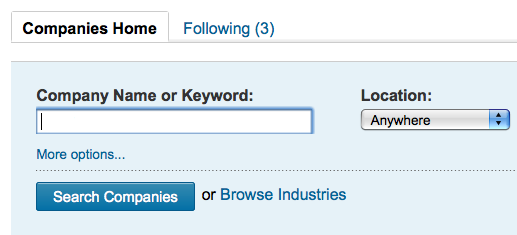
Search companies or browse industries, and LinkedIn will show if you have anyone in your network working in those organizations. When you follow companies, you’ll receive regular updates when someone working for that company updates his or her profile indicating a change in position — maybe suggesting an opening to pursue via your network!

In fact, LinkedIn just released information suggesting the best months (statistically, per their network) to get a promotion. Their press release noted a Buck Consultants survey, “Compensation Planning for 2011,”saying workers in the U.S. can expect only modest pay raises this year, although salary increases for 2011 will average 2.8 percent, an increase from the two previous years.

According to LinkedIn’s data, the top three months for professionals in the U.S. to get promoted within their company are:

  1. January
  2. June
  3. July

Interestingly, their data show professionals in accounting, defense & space, education management, higher education, military, non-profit organization management and research tend to see a spike in promotions over the summer months more than other industries.

The data indicate a generational link to the timing of promotions. Their study notes that Millennials (born in the 1980s) “are the most likely to be promoted throughout the year (rather than just in January which is the case for most professionals).”

Job seekers (and anyone driving their own “career bus” should take advantage of LinkedIn’s tools. The amount of data they access regarding professional trends and the services they provide are extremely useful beyond simply sharing a profile. DJ Patil, LinkedIn’s chief scientist explains,

“LinkedIn was launched in 2003, but our data allow us to identify professional trends that span decades…By shedding light on professional patterns, we hope to help our members achieve their career goals by using LinkedIn in the most effective and productive way possible.”

“One of the best ways to get promoted is by promoting yourself,” said Lindsey Pollak, a career and workplace expert. “LinkedIn is the perfect place for professionals to get clients, vendors and other third parties to post recommendations on their profile. By encouraging other professionals to champion the work you do in your current role, you’ll be more likely to advance to the next level.”

Take a look at how LinkedIn suggests you leverage their social network to land a promotion:

Shine the Spotlight on New Skills

Impress your manager by learning new skills that go above and beyond your current role. Make sure your LinkedIn Profile is complete and includes all the skills you’ve acquired. Expanding your horizons while working full time is a commendable endeavor that’s worth calling attention to. If your company offers an education reimbursement program, take advantage of it. If you have industry certifications or went back to school for a higher degree, mention them in your profile and during your review.

Get Connections in High Places

LinkedIn Advanced People Search lets you search by title so you can find professionals that have the position you want to be promoted to. Reaching out to mentors and peers is one way to prep for that 2011 promotion. After the promotion, a strong relationship with a peer will give you a friendly ear you can rely on for advice if things get tough.

Toot Your Horn

Remind your manager of your accomplishments. Even if they were monumental, he or she may have forgotten about them. Document milestones in your career by requesting quality recommendations on LinkedIn. If a customer sends you an email thanking you for the amazing event you put together for them in record time, gently suggest that they provide you with a recommendation (if they feel comfortable doing so) and also forward the email to your manager so they’re aware of the praise you’re receiving.

photo by nan palmero

Filed Under: Career Advice, Social Networking Tagged With: career coach, how to get a job, how to use linkedin, keppie careers, Lindsey Pollak, linkedin, Miriam Salpeter, when to get a promotion

Career tip — Find out what people think of you!

December 7, 2010 By Miriam Salpeter

In October, I attended the Career Directors International conference in San Diego, but I have been so busy traveling and attending events since then, I have not had a chance to write about it yet!

One thing I did when I was there was take some video of my friends sharing their “best career tip.” Today, a tip from Susan Kelly-Easton of Competitive Edge Career Services.

It was so much fun meeting and spending time with Susan, and I am delighted to share this tip with you!

One way to collect this input is via the Reach 360, a tool that is available for free online for a 15-day test. It allows you to request feedback from people anonymously and to learn what your contacts and colleagues think of you!

Filed Under: Career Advice Tagged With: best career tip, career coach, Career Directors International, how to get a job, keppie careers, Miriam Salpeter, Susan Kelly-Easton

What business owners and job seekers have in common

November 9, 2010 By Miriam Salpeter

It was exciting to attend Social Media for Start ups, a panel that is part of Social Media Atlanta’s events this week. The experts provided lots of great advice that is relevant for those planning to start businesses, but also for anyone seeking a job.

The panel was moderated by Laura Nolte, Principal – Green Theory. Panelists were:

Adam Rice, Co-Founder – Looxii

Jeremy Porter, Founder – Journalistics

Lance Weatherby, Startup Catalyst – ATDC at Georgia Tech

Nicole Jayne, Social Media Manager – Scoutmob

Sarah DeVries, BlinqMedia

Some takeaways:

Lance made a point about “social proof,” a term that means you show, rather than tell, what you have to offer. Someone who demonstrates a social proof may be applying for a job in social media and do so by using social media in a particularly unique or clever way. The concept of social proof is key for entrepreneurs and start up businesses — they need to show what they can get done. It is also important for job seekers. Always be thinking about how to PROVE that you have the skills, experience and expertise you say you have. Think, “show, don’t tell.”

Adam and Jeremy suggested staying flexible and focusing on what customers want…Another crossover here between a start up and a job seeker. While I advocate job seekers target organizations and opportunities, sometimes, it is necessary to make adjustments in job search strategies. Be prepared to adjust if you want to succeed. For job seekers, the “customer” is the hiring manager. Focus on what he or she wants. Be that person (assuming you are!)

Jeremy suggested that start ups focus on building communities via social media (via blogs and using Twitter)  in the pre-launch phase. He noted that the product could be great, but that the community adds value. Sarah added that word of mouth is key for start ups and suggested relying on friends (and, by extension – social media friends) for buzz. Again — a perfect analogy for job seekers. Build your network before you need it. (Before you are job hunting.) You may be amazing, but it doesn’t matter if no one knows about you. Create a community (or more than one) and rely on it when you are in job search mode.

Jacqui Chew, principal of iFusion Marketing, provided several great insights from the audience. She pointed out that to gain credibility, you need to create your own content and become a go-to resource for your niche. She reminded the audience to provide value by building an audience. Perfect advice for job seekers as well as start ups!

Sarah suggested start ups avoid long, drawn out campaigns because they cause reader fatigue. If you see the same ad on Facebook for a month, you will probably ignore it at some point, right? The same goes for job seekers. Don’t be the “job seeker” who does nothing but look for a job, talk about looking for a job and asking people if they “know anyone.” Instead – remember the previous point – think about how you can provide value and gain credibility. How can you connect for content?

Jeremy commented that start ups need to balance “push ideas” with “pull ideas.” This is absolutely crucial for job seekers as well. You cannot rely on finding a job by sending out resumes and applications. Think about how you can attract people to you. (See “create content.”)

Think about how you can incorporate these ideas into your job search. Can you do anything differently that may achieve a better result?

Filed Under: Career Advice, social media Tagged With: Adam Rice, BlinqMedia, business owner, career coach, Green Theory, how to get a job, iFusion Marketing, Jacqui Chew, Jeremy Porter, job search, Journalistics, keppie careers, Lance Weatherby, Laura Nolte, Looxii, Miriam Salpeter, Nicole Jayne, Sarah DeVries, Scoutmob, Social Media Atlanta

What job seekers can learn from employers

October 23, 2010 By Miriam Salpeter

At the Society for Human Resource Management, Atlanta conference, I made a point to attend several sessions addressing social media. These sessions were directed to recruiters and human resource professionals responsible for attracting top talent to their organizations. Job seekers can learn a lot from the conversations. [Read more…] about What job seekers can learn from employers

Filed Under: Career Advice, social media Tagged With: career coach, how to get a job, Jenny DeVaughn, job search, keppie careers, Miriam Salpeter, SHRM Atlanta, social media, what employers are thinking, where employers are looking for candidates, whre to look for woork

How to influence people

October 20, 2010 By Miriam Salpeter

If you follow me on Twitter, you will know that I have been busy tweeting up a storm from the Career Directors International conference (#CDI10) and the Society for Human Resource Management (SHRM), Atlanta conference (#SHRMATL10)  in the past week.

Today, I want to share some insights from Tom Herringon, a senior partner with The PAR Group. Tom spoke at SHRM Atlanta about the art of leadership and influence. It’s an important topic, both for managers and those in leadership positions and for job seekers who hope to influence people to hire them.

A few key points from Tom:

  • Everyone is a decision maker. Telling people to do something is not effective; influencing them to take action is best.
  • No decision is made without emotion. Gut instincts and feelings influence every decision we make.
  • If you want to know how people feel, don’t pay attention to what they say, pay attention to their actions. Consider how they are speaking and what they actually do. Actions are easy to see, emotions are not. (I will have more insights about how to listen with all of your senses in my post about Beverly Inman-Ebel’s talk regarding listening. Hint: it’s not something you should be doing only with your ears!)
  • Salesmanship done right looks like leadership.
  • Leaders evaluate situations to allow themselves to be more easily followed.
  • Leaders are inflexible about their goals, outcomes, objectives and targeted results. They are flexible about HOW to get there.
  • Recognize that the decision about what to do rests with the individual. You can’t “make” someone take a specific action, but you can empathize, acknowledge their needs and respect their opinions in an effort to impact behavior.

Tom suggested acknowledging and respecting people, in part by suspending your point of view, empathizing with the other person’s viewpoint and depersonalizing the interaction. For example, instead of starting sentences with “you,” think about using “It” or “That” statements.

While Tom’s talk was for human resource professionals, there were many takeaways for job seekers:

  • Your search is not only about being qualified for the job — people also hire based on what feels “right” to them — emotion is a key factor in hiring decisions. If you are not getting the job, it does not mean you are not qualified, it may relate to a larger issue of how you come across,  how you present yourself or how you make people feel. Self awareness about these topics may be difficult. Ask a trusted friend or coach if you think these factors may be preventing you from getting hired.
  • In an interview, what people say is not always how they feel. An interviewer may tell you one thing, but if they look disinterested, check their watch, or don’t make eye contact, the important information is probably the non-verbal communication.
  • You (the job seeker) are a decision maker, too. Remember — you are evaluating the employer in an interviewer, even as he or she assesses your qualifications for the job. Maybe the organization is not a good fit for you.
  • Think about what you can do to make yourself a leader. Tom said, “Leaders evaluate situations to allow themselves to be more easily followed.” What are you doing to help people decide to follow you? Think about how to use social media tools to share your expertise. Wouldn’t it be great to have people coming to you with job opportunities instead of you applying for every job you want? (It is possible — I coach job seekers and entrepreneurs to leverage these tools for results.)

What other ideas to you have about the topic of influence and leadership, especially as they relate to the workplace and job search? Please share your thoughts in the comments.

photo from thegoldguys.blogspot.com/

Filed Under: Career Advice Tagged With: carer advice, how to be a leader, how to get a job, how to get people to follow you, influencing people, keppie careers, leadership, Miriam Salpeter, SHRM Atlanta, Tom Herrington

  • « Go to Previous Page
  • Page 1
  • Interim pages omitted …
  • Page 32
  • Page 33
  • Page 34
  • Page 35
  • Go to Next Page »

Follow Us!

  • Facebook
  • Instagram
  • LinkedIn
  • Pinterest
  • Twitter

Be an Insider: Sign Up to Receive Special Offers & Free Gift


About Keppie Careers

Are you a job seeker or business owner? You’ve come to the right place!
Click here to find out more.

Contact Us

Have a question or comment?
Click here to Contact Us.
© Copyright 2024 Keppie Careers