• Skip to primary navigation
  • Skip to main content
  • Skip to footer

Keppie Careers

Social media speaker, social media consultant, job search coach

  • About
    • Expert Job Search and Social Media Consultant / Speaker
  • Services
    • For Job Seekers
    • For Entrepreneurs
    • Social Media Coaching and Consulting
    • Speaking/Keynotes
  • Resources
    • Sample Resumes
    • Quoted In
  • Books
  • Blog
  • Contact

Job search advice from recruiters

April 5, 2011 By Miriam Salpeter

Last week, I was a guest at an iRelaunch Return-to-Work Conference in Atlanta. It is always a pleasure to have a chance to hear from recruiters, and, in this case, also from a number of women who returned to work after taking some time off. Carol Fishman Cohen and Vivian Steir Rabin, the co-founders of iRelaunch and authors of Back on the Career Track: A Guide for Stay-at-Home Moms Who Want to Return to Work, put together several terrific panels and seminars for those attending.

The employer panel included:

Elizabeth Russel, Director of Change Leadership — Emerson Human Capital

Kathy Davis, Recruiting Manager — Accenture

Michelle Wilkinson, Leadership Recruiting Manager — Wellpoint Inc.

The panelist share a number of good tips for job seekers…

Ms. Russel commented on how important it is to demonstrate your ability to manage projects, an across-the-board skill to demonstrate on the resume. Other top picks to highlight? The ability to meet deadlines, manage a team and to fit the organization’s culture. Ms. Davis noted the importance of referencing key words in a resume and suggested using LinkedIn to connect with people at your target companies. She believes it is a great idea to use Twitter to network and gain and share information and explained it was important to “make your voice heard.”

The recruiters differed in their opinions about cover letters, with Ms. Davis saying she doesn’t always read them, while Ms. Wilkinson believes a cover letter is “quite important.” This is typical of advice regarding cover letters — some read them, others ignore them, so it’s a bit of a toss-up for job seekers. The best advice seems to be to write a strong cover letter, in case it is valued.

The panelists agreed it was important for the candidate to indicate on the resume why he or she left a job or had a gap. For example, “left to care for ill parent” or “stayed home with infant daughter.” They even suggested noting things on the resume such as, “department closed” or “company bought out.” Ms. Russell suggested not “over explaining” a gap, but believed (as did the others) that it was important to account for time off of paid work.

Job seekers may be interested to know that the employers agreed volunteer work, especially board-level work and significant volunteer contributions should be highlighted on a resume when appropriate. In fact, Ms. Wilkinson explained “community work is key at WellPoint,” so showcasing it would be particularly significant. This is a great reminder to identify an organization’s key culture points in order to illustrate why you are well-suited for the job. Sometimes, that cultural fit can really make a difference between two equally qualified candidates.

As for resume length, the general rule of thumb was two to three pages, and all three women agreed referrals from within the company were valued. They suggested asking the recruiter or hiring manager about appropriate intervals for following up and emphasized it was a great question to ask at the interview.

Their final words of wisdom:

Ms. Wilkinson: Know what you want to do. The worst thing is when a candidate does not know. Do your homework about the company and industry and be prepared for the interview.

Ms. Davis: Don’t sell yourself short. Take phone interviews seriously – be sure to smile, even though you’re on the phone; it makes a difference!

Ms. Russell: Dress up for those phone interviews. Be open minded. Recognize your next role may not have existed five years ago!

photo by K’vitsh

Filed Under: Career Advice Tagged With: Carol Fishman Cohen, Elizabeth Russell, how to get a job, how to get back to work after a break, iRelaunch, job advice from recruiters, job search, Kathy Davis, keppie careers, Michelle Wilkinson, Miriam Salpeter, social media, Vivian Steir Rabin

Celebrating Kindness Day – How to help a job seeker

April 3, 2011 By Miriam Salpeter

Today, my colleague Phyllis Mufson invited me to participate in “Kindness Day.” Via her blog, she suggests perpetrating kindness via Twitter by doing and tweeting acts of kindness, using the hashtag (search tag) #Kindness.

Writing about job search and interacting regularly with job seekers, I thought it made sense to also contribute a brief blog with tips about how to be kind to job seekers. It’s very easy to make half-hearted offers to help someone in the midst of a job search. Everyone has made one of these offers in one way or another: “Let me know what I can do to help.” Or, “I’m happy to help, just let me know what you need.”

It’s easy to say, but unlikely to encourage the job seeker to follow through. We all know it’s difficult to ask for help — job seekers are no more likely to follow up with your offer than someone with a broken leg you tell to “let me know what I can do.” We’re all self-sufficient and don’t like to accept assistance.

What’s a better suggestion, in honor of Celebrating Kindness Day? Just do something nice! Here are some suggestions that came to mind.

  • Invite a job seeking friend to meet for coffee with a contact who might be able to help him or her connect with a company of interest.
  • Ask the job seeker what companies interest him or her. Review your own network; if there is a good contact, invite both to meet for lunch and facilitate an in-person introduction.
  • If you’re attending an event that could be useful for your job seeking friend, invite him or her to go with you and make a point facilitate targeted introductions.
  • If you’re a close friend, offer to do something nice personally — offer to babysit, so the job seeker can have some time alone – for job hunting activities or just to relax.
  • Keep an eye out for useful information that could assist the job seeker, and pass it along. If you hear of well-suited opportunities, offer to forward a resume and actually make an effort to connect the job seeker with the opportunity.
  • Peruse your own social networks — your LinkedIn, Twitter and Facebook connections — for possible good contacts for the job seeker. Do everything you can to facilitate their connection.
  • Keep an eye open via your own networks about resources such as Hiring for Hope/Job Angels — where volunteers offer to assist job seekers.

What other ideas do you have? What have you done to help a job seeker? If you ARE a job seeker, what’s the best thing someone could do for you? Also share tips of what is NOT kind — or not helpful — for job seekers.

Thanks to this group of Twitter users for co-hosting Celebrating #Kindness Day! Be sure to follow them and tweet some kindness today with the #Kindness hashtag!

Kim Wells @kwells2416 http://Twitter.com/kwells2416
Susan Smith @togetherwf http://Twitter.com/togetherwf
Dave Carpenter @Dave_Carpenter http://Twitter.com/Dave_Carpenter
Sarah Hodsdon @Sarahndipitous http://Twitter.com/Sarahndipitous
Georgia Feiste @feistycoach http://Twitter.com/feistycoach
Jacob Share @jacobshare http://Twitter.com/jacobshare
Melissa Cooley @TheJobQuest http://Twitter.com/TheJobQuest
Phyllis Mufson @PhyllisMufson http://twitter.com/phyllismufson

photo by the_moment

Filed Under: Communicating, Job Stories Tagged With: career coach, help a job seeker, Hiring for Hope, how to help a job seeker, keppie careers, Miriam Salpeter, social media

How to make it easier to find you online

March 30, 2011 By Miriam Salpeter

Job seekers often hear how important it is to make it easy to find information about you online. Why? A Cross-Tab research study, Online Reputation in a Connected World, points out:

  • 75 percent of HR departments are expected to research candidates online
  • 89 percent of hiring managers and recruiters review candidates’ professional online data
  • 86 percent of employers believe a positive online reputation influences their hiring decisions—and nearly 50 percent say the influence is “to a great extent” and they expect it to increase

Further proving how important it is to be discoverable online is an ExecuNet Inc. research study, 2010 Executive Job Market Intelligence Report:

  • 90 percent of search-firm recruiters regularly Google candidates to help draw a complete picture of that individual—up from 75 percent in 2005

If you have a common name, it may be difficult to distinguish yourself online. About 2,000 people on LinkedIn share their name with someone on the FBI’s most wanted list, says James Alexander, founder of Vizibility.com, a company that creates tools to help professionals and companies stand out on the Web.

Read the rest of the post on my U.S. News blog….

photo by dunkr

Filed Under: Personal Branding, social media, Social Networking, Uncategorized Tagged With: career coach, how to get a job, job hunt, keppie careers, Miriam Salpeter, Vizibility, why having an online profile matters

Should you leave dates off your resume?

March 23, 2011 By Miriam Salpeter

Regular readers know I always tell my clients there is no ONE RIGHT way to conduct a job search. Best practices? Yes. Opinions on the best way to do things? Absolutely! The trick is to identify people who provide opinions based on actual information from people involved in hiring. Unfortunately, there are a lot of people advising job seekers based on nothing but their own experience, which may or may not translate effectively to others.

One slightly controversial piece of advice regarding resumes is about using dates. Typically, when I hear arguments about including dates or not on a resume, the focus is on graduation dates, but I’ve recently become aware that some people are advising job seekers to list some of their job experience without dates.

Graduation Dates on Resumes

Some people believe if they graduated from college too long ago, hiring managers will pass over their resume, assuming them to be too old, too inflexible or too expensive to hire (based on the number of years of experience).

Advice to remove graduation dates targets younger and younger people! I had one client tell me he’d been advised to take the years off of his schooling since it had been more than five years ago. That is an extreme piece of advice. Generally, anyone over 50 may be told to make themselves “look younger” by removing graduation dates.

Need help knowing what to say and how to say it in job search?
Check out my new book: 100 Conversations for Career Success

Should you leave graduation dates (years) off of your resume? I’m not a fan of this practice. Why? Because, if you leave off the date, you allow the reader to assume when you may have graduated. The hiring manager will naturally believe you are “more experienced” — perhaps even much more experienced (read: older) than you actually are! If your goal is to look younger, that’s what we on Twitter would label a major #FAIL.

Are there circumstances where leaving off graduation dates may make sense? Possibly. If you could have retired 10 years ago, you probably can’t hurt yourself leaving off your graduation date!

Dates for Experience

I’m working with a client now who has been advised to list certain jobs she held in the past without dates. Not all of her work experience, just a few older positions. At first, I thought she had misunderstood the previous career advisor’s instructions, but from talking to a few people, it appears as if this advice to omit dates on certain job experiences is typical.

My bias is to always include dates on experience; I thought it was crazy to advise a job seeker to leave dates off of certain work experience. (My preference would be to leave off the jobs altogether if they were not crucial to the candidate’s time line. For example, account for the last 10-15 years of experience and omit older jobs that don’t add anything to your candidacy.)

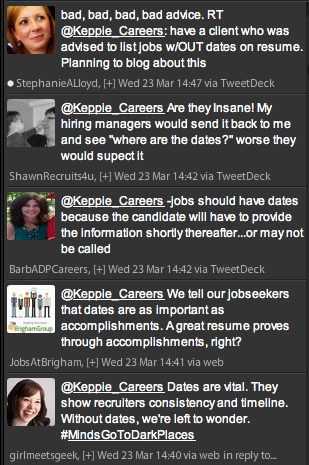
I’ve spent a lot of time with recruiters who influence some of my advice to job seekers. Granted, most jobs are not filled via recruiters, but I believe their take on resume norms is valuable, since they constantly evaluate candidates. I posed the question of dates on a resume to my Twitter community, saying, “#Recruiters -I have a client who’s been advised to list jobs withOUT dates on resume. Planning to blog about this. Love to quote you!”

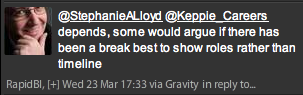
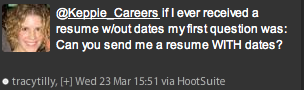
These are the replies I received. Read them from the bottom up to follow the conversation.

While @RapidBi, an organizational change consultant, believed there could be a case for a resume without all of the dates, clearly the trend in this unscientific survey points toward including dates or risking attracting suspicion.

If someone is telling you to leave dates off of your resume, only do so after carefully considering the possible ramifications. Have I heard of people who removed certain dates (typically graduation dates) and still landed interviews? Yes, I have. Be sure to make your decision from an informed perspective. Ask you advisor or coach why he or she recommends one way or another; don’t be afraid to inquire why. Anyone who knows what they are doing will welcome the opportunity to explain.

— If you’re looking for a job and could use a boost, be sure to pre-order a copy of my book, Social Networking for Career Success AND consider getting your own, personal website – a social resume!

photo by Caro’s Lines

Filed Under: Resume Advice Tagged With: career coach, how to get a job, keppie careers, Miriam Salpeter, older job seekers, should you include dates on your resume, tricks for experienced workers

What one person’s bad luck shows about the power of Twitter

March 18, 2011 By Miriam Salpeter

No doubt getting fired for something said, posted or tweeted often makes the news. This week in Atlanta, Chadd Scott, a radio personality, lost his job for tweeting disparaging things about Delta Airlines, an Atlanta based company that also happened to be a key client for the station where Chadd worked. 11 Alive News, the NBC affiliate in Atlanta, reported Delta threatened to pull their ads from the station. 680 The Fan Radio fired him for tweeting comments such as:

“The bean counter who saved Delta a few bucks in st. lou hoping he wouldn’t need more de-icing fluid this year screwed a lot of people today.”

“Not a big quote tweeter, but #delta should remember ‘when you fail 2 prepare, you prepare 2 fail.'”

“New #delta strategy on de-icing planes in st. louis: wait ’til it melts. well, the company is based in atlanta.”

While it’s unfortunate these tweets landed Chadd in such hot water, the most important lesson job seekers can learn from this story: companies ARE listening! It’s possible to get someone’s attention via Twitter, and to use it to your advantage.

11 Alive reporter Jaye Watson interviewed me about what Chadd did wrong and how people can use Twitter to attract positive attention.

picture by xotoko

Filed Under: Career Advice, social media Tagged With: career coach, Chadd Scott, fired for tweeting, how to get a job using Twitter, Jaye Watson, keppie careers, Miriam Salpeter, social media coach, Twitter

  • « Go to Previous Page
  • Page 1
  • Interim pages omitted …
  • Page 95
  • Page 96
  • Page 97
  • Page 98
  • Page 99
  • Interim pages omitted …
  • Page 214
  • Go to Next Page »

Follow Us!

  • Facebook
  • Instagram
  • LinkedIn
  • Pinterest
  • Twitter

Be an Insider: Sign Up to Receive Special Offers & Free Gift


About Keppie Careers

Are you a job seeker or business owner? You’ve come to the right place!
Click here to find out more.

Contact Us

Have a question or comment?
Click here to Contact Us.
© Copyright 2024 Keppie Careers