• Skip to primary navigation
  • Skip to main content
  • Skip to footer

Keppie Careers

Social media speaker, social media consultant, job search coach

  • About
    • Expert Job Search and Social Media Consultant / Speaker
  • Services
    • For Job Seekers
    • For Entrepreneurs
    • Social Media Coaching and Consulting
    • Speaking/Keynotes
  • Resources
    • Sample Resumes
    • Quoted In
  • Books
  • Blog
  • Contact

Overcome job search frustration by making some changes in your job hunting routine

August 21, 2011 By Miriam Salpeter

Whether we are in for another recession or not, if you’re looking for a job, the economic news is a little scary. A recent job fair in Atlanta attracted so many participants, people waited outside in the heat for hours, just to get in the door. Many left, frustrated, because they were told to apply online.

Last week, I joined CNN anchor Fredricka Whitfield on the air to share some tips with job seekers. (Stay tuned for a link to the segment.)

Here are some tips to help you change directions if things aren’t going well.

Biggest job seeker mistakes:

  • Using the same resume to apply for every job and not personalizing it for employers’ needs. You need to spoon feed your resume to the employer. If you aren’t customizing it, you’re doing the equivalent of feeding a toothless infant a whole apple — she’ll likely use it to play a game of “drop and get.” Ideally, you’ll offer applesauce to a baby, and a resume detailing what you can do to solve the employer’s problems.
  • Applying for the wrong jobs. It’s tempting to apply for “just any job.” After all, YOU know you can do anything, right? It’s possible you can, but writing to an employer with a broad statement offering to be interviewed for “any” job is a recipe for disaster. The employer doesn’t know what to do with you and thinks you are desperate. In other words, you don’t hear back.
  • Ignoring social media resources or assuming they won’t make a difference. How many job seekers have been looking for work for over a year, but have never even tried using LinkedIn, Twitter or even Facebook to see how social media may help get them out of their job hunting rut? Too many, in my opinion. Using social media well is a big step in the right direction.

How to best use social media

  • Choose the best networks for you – the ones that highlight and show off your skills. For example, if you love to write (and you’re a good writer), a blog might be great for you. If you’re a better talker, consider creating an online radio program. I outline many different social networks in my book, Social Networking for Career Success.
  • Completely fill out your profiles using key words – the words people will use to find someone who does your type of work. It’s important to do this well so it’s easier for people who may want to hire someone with your skills to find you.
  • Find people online in your field of work. Use the various search tools in the different networks to identify potential contacts. For example, in LinkedIn, use “advanced search” to locate contacts and join groups pertaining to your interests. Use Listorious.com and WeFollow.com to find people with common interests using Twitter. See what they are saying online, respond, add to the conversation. Try to become known as a person who is “in the know,” is friendly and giving. Do not ask for job leads until you establish a relationship. You may be surprised by how generous your new online contacts are!

In my next post, I share “before” and “after” resume samples and provide specific tips to help update your resume.


Filed Under: Job Hunting Tools, Uncategorized Tagged With: avoid job search frustration, biggest job seeker mistakes, career expert, CNN, Fredricka Whitfield, how to best use social media to find a job, how to find a job, keppie careers, Miriam Salpeter, Social Networking for Career Success, why use social media to find a job

Simply Hired reports opportunities up for job seekers

March 11, 2011 By Miriam Salpeter

In Simply Hired’s February Jobs Report, there were some silver linings for job seekers.

They reported growth in 17 of 18 industries; only Technology was down a bit (-2.0%). Reported large growth areas: Military (22.7%), Travel (20.9%) and Agriculture (20.0%)

Month-over-month, growth in job openings (based on posted jobs on Simply Hired) were up 3.8% and year-over-year (compared to February 2010), they were up 49.7%.

There are (statistically) 4 people for every 1 job opening nationwide. Top hiring companies nationwide included:

  • Home Depot
  • HCA
  • Securus
  • Starbucks
  • U.S. Air Force

Top hiring sectors based on jobs listed on Simply Hired included: agriculture, automotive, construction, education, financial services, government, health care, hospitality and legal.

Statistically, the most competitive place to land a job was Miami and Fort Lauderdale, where there are 9 candidates for every one opening. Washington D.C. has one job for every one candidate. (Remember, this is a statistical analysis, which doesn’t necessarily mean you will or will not be able to land an opportunity.)

Daniel Greenberg, CMO, SimplyHired.com, explains how they calculate these ratios and what they mean for job seekers:

SimplyHired.com’s unemployment ratio is calculated by taking the average of the total number of currently unemployed persons in the U.S. (as reported by the Bureau of Labor Statistics) over the total number of job openings listed on SimplyHired.com each month. In February, the unemployment ratio was 4:1 nationally. This means that on average there were four job seekers for every one job opening. What this means for job seekers varies by location, if you’re looking for a job in an area like Miami, the unemployment ratio is actually 9:1, and in Washington, DC the unemployment ratio is an ideal 1:1.

This ratio also includes every job opening, meaning that part-time and contract work is considered – not just full-time jobs. Everything else being equal, job seekers in highly competitive job markets would be well served to relocate to areas that have more favorable job seeker-to-unemployment ratios.”

—

If you’re looking for a job — or thinking you need to start using social media to propel your career, my book: Social Networking for Career Success is available on Amazon (at a great discount). Please order now!


photo by Redvers

Filed Under: Communicating, Cover Letters, Job Hunting Tools, Job Stories Tagged With: career coach, Daniel Greenberg, how to find a job, jobs data, keppie careers, Miriam Salpeter, Simply Hired, social media

Newest updates from LinkedIn

March 10, 2011 By Miriam Salpeter

I was delighted to be invited to attend LinkedIn’s latest press conference (via live stream from their headquarters). No question LinkedIn is working hard to compete with other, growing social networks, such as Facebook and Twitter.

An interesting point made in the early part of the conference: LinkedIn wants to emphasize itself as a network helpful for job seekers, but not JUST for people looking for jobs. They strive to be a place for people to share insights, build relationships  and update profiles to illustrate expertise and offer information all of the time. I’ve been promoting this concept for years, and it was not surprising to know that being a go-to network for every professional is one of LinkedIn’s goals.

The three objectives they outlined:

  1. Be the professional profile of record to help people find and be found, ultimately eliminating the need for the “cold call.”
  2. Be a source of professional insights with a focus on making content relevant to readers.
  3. “Work where our members work,” in other words, create applications to use via smartphones and on the go in addition to on the Web.

Some of their latest – and newly announced features:

LinkedIn’s InMaps – allow you to visualize your LinkedIn social graph (the people you are connected to and how they connect to each other). You can learn where there are pockets in your networks and consider where you may want to expand your connections, and it’s all via a visual tool. (The picture above is a piece of an InMap. Try it out: http://inmaps.linkedinlabs.com/.

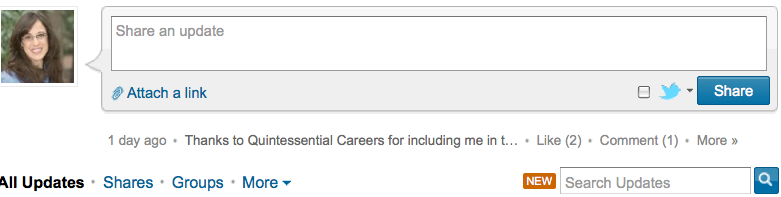
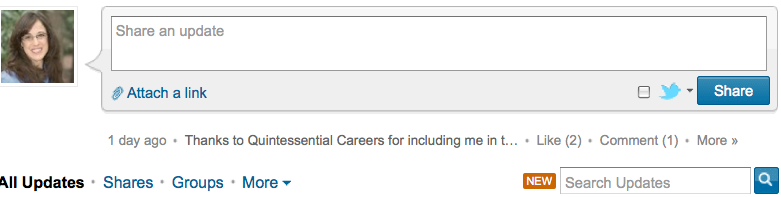
LinkedIn’s Signal – This has been in beta in September 2010, and today is available for everyone. Find this on your LinkedIn home page or via http://www.linkedin.com/signal. (See picture below — the link is in the bottom, right corner – Search Updates.)


See updates from your immediate or expanded network, or information shared by company or industry, location, time, University, or any combination of those search parameters. This gives you access to updates from people who are not in your network.

This search is sort of similar to searching a hashtag on Twitter, which shows you updates from everyone – not just your network – using that search term. LinkedIn aims to share “professional” updates with you via this tool, but this all depends on how your network or the network you are searching uses LinkedIn. Let’s face it, there are plenty of updates that are not exactly “professional.” I found many by searching only by city. However, in theory, this type of search should clue me in to what professionals in a given city are thinking and sharing. (Searches by industry are more focused and will likely produce useful results.)

LinkedIn Today Beta. Find this at http://www.linkedin.com/today. LinkedIn calls it, “A new product that surfaces the top headlines and stories being shared the most across multiple industries by LinkedIn’s trusted network of more than 90 million professionals.”

They explain, “LinkedIn Today gives members a customized and tailored way to consume the top trending news relevant to a particular industry and by what is being shared the most frequently by those industry’s professionals. It lets members access their professional news through three different lenses – by their connections, industry, and the broader global professional network.”

LinkedIn Today integrates with Twitter and StumbleUpon and other news sources, including Bloomberg.com, Wall Street Journal Digital Network, CNNMoney, and many more. They also integrated this into their iPhone app (version 3.6), which has special features allowing users to quickly access the news they need.

Learn more about this new feature by taking the “tour” offered right below the site’s headline. It’s easy to personalize the experience and save stories so you can track the information you want.

Be sure to take advantage of these useful tools, whether you are looking for a job, have a business, or just know you need to keep up-to-date to stay ahead of the game professionally!

Want to learn all about how you can use social networking to propel your career? My new book, Social Networking for Career Success, is available for pre–order (at a great price). I want to invite you to order now!

Filed Under: Job Hunting Tools, Networking, social media, Social Networking Tagged With: career coach, how social media helps job seekers, how to use LinkedIn Signal, how to use LinkedIn Today, keppie careers, LinkedIn InMaps, LinkedIn Today, LinkedIn updates, Miriam Salpeter, social media

LinkedIn adds new functionality to ‘Company’ search

February 26, 2011 By Miriam Salpeter

LinkedIn’s blog reported yesterday that you can now search “for companies not only by attributes such as location, industry, and size but also by how you are connected. You can filter a set of results to include only those companies where you have a direct connection or broaden your search to include companies in your extended network.”

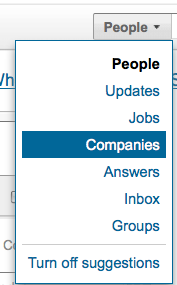
Hopefully, you have already been following companies (read more about following companies on LinkedIn here), but this is a pretty neat improvement. All you need to do is go to the top toolbar, select companies (see picture) and include keywords (which could be city, industry, etc.). LinkedIn finds a list of companies with your criteria where you have connections in your network. LinkedIn links you to those contacts and lets you know which companies currently list jobs in LinkedIn.

You’ll also have a chance to follow the company, which helps you track what is going on there. Take a look at LinkedIn’s video describing the new search function:

http://www.youtube.com/watch?v=1j5VoN_v-Us&feature=player_embedded

I think job seekers (or anyone thinking of making a change) will find this new functionality extremely useful! Be sure to keep up with The LinkedIn blog for updates.


Filed Under: Job Hunting Tools, social media Tagged With: career coach, how to find a job, how to use linkedin to find a job, keppie careers, linkedin, Miriam Salpeter, social media coach

Why you need your own website – and how to get one!

February 20, 2011 By Miriam Salpeter

Do you believe you need an online presence to help you land a job — or to help you manage your career? I spent 45 minutes last week trying to convince a career-changing friend she needed HerName.com. She is finishing an advanced degree and will be looking for opportunities in a teaching specialty. She can’t understand why it is important to have an online presence, and she made some good points:

  • I’m going to get a job because my professor recommends me to a colleague; it doesn’t have anything to do with having a website.
  • I’m not comfortable having information about me online that just anyone can find.

I tried my go-to reasons to explain why her own site was a good idea:

  • Even if your professor recommends you for the job, it’s likely the hiring manager will also Google you. What will she find?
  • A personal site is a way to control how your name appears online.
  • Statistics show your online presence matters, and that employers are looking for personal and professional data about you.
  • In fact, while you may think you have “privacy” online, NOT putting up your own site only gives people an incentive to look deeper in the web for information about you. Take a look at these sites to learn what the “deep web” knows about you: pipl.com, Polymeta.com.
  • Managing a site is important for career insurance and professional development. Showcasing your expertise online (even if it is in a new field) helps demonstrate what you have to offer, even when you aren’t looking for a job. An online presence can grow and change along with your career and help attract people to learn more about you. This could result in opportunities to speak at conferences or events, or even invitations to apply for jobs down the road.

None of this persuaded her. Finally, I came up with one last point…Something I’ve written about, but hadn’t thought to bring up during our conversation:

  • Having a website suggests you have some technical savvy and understand how to use online tools to communicate. That, in and of itself, is an important skill many employers value. It’s known as “social proof.” You may say you know about technology on your resume, but actually using it to showcase your own information goes a long way to prove you have what employers want.

Finally! She replied…”I can see how that would be important.” Noting technology in the classroom is key, and knowing how to use it could be useful, she acknowledged the “social proof” argument was more persuasive than anything else I said.

Especially if you are transitioning to a new job or an experienced job seeker who needs to overcome age discrimination, having an up-to-date online presence and maybe even a viable blog helps show prospective employers you’re willing to learn and are perfectly capable of keeping up with technology.

Maybe you, like my friend, are skeptical. You can’t envision how and why having an online presence will help you get a job, manage your career or become known as an expert in your field. Since I spend so much of my time keeping up with job search strategies and researching tools job seekers and careerists need to use, it’s so clear to me that having YourName.com is crucial to your professional identity and to managing your career.

That’s why I created a product/service to help people (even the skeptical ones) secure and manage their own websites. I’m giving it away for a steal (a colleague told me I should be charging $1000+). Think about how your investment can help you move in the right direction for your career and visit my new site to learn how to get a social resume: http://www.getasocialresume.com/.

photo by nyuudo

Filed Under: Job Hunting Tools, Resume Advice, social media, Social Networking Tagged With: career coach, get a job, how to find a job, Miriam Salpeter, social resume, why you need an online presence

  • « Go to Previous Page
  • Page 1
  • Interim pages omitted …
  • Page 4
  • Page 5
  • Page 6
  • Page 7
  • Page 8
  • Interim pages omitted …
  • Page 16
  • Go to Next Page »

Follow Us!

  • Facebook
  • Instagram
  • LinkedIn
  • Pinterest
  • Twitter

Be an Insider: Sign Up to Receive Special Offers & Free Gift


About Keppie Careers

Are you a job seeker or business owner? You’ve come to the right place!
Click here to find out more.

Contact Us

Have a question or comment?
Click here to Contact Us.
© Copyright 2024 Keppie Careers