• Skip to primary navigation
  • Skip to main content
  • Skip to footer

Keppie Careers

Social media speaker, social media consultant, job search coach

  • About
    • Expert Job Search and Social Media Consultant / Speaker
  • Services
    • For Job Seekers
    • For Entrepreneurs
    • Social Media Coaching and Consulting
    • Speaking/Keynotes
  • Resources
    • Sample Resumes
    • Quoted In
  • Books
  • Blog
  • Contact

5 things you haven’t tried to help you land a job

February 7, 2011 By Miriam Salpeter

I know how frustrating it is for job seekers who think they are  “doing everything they can,” but still can’t land a job. It’s empowering to realize there are probably strategies you have not tried and new, assertive approaches to expanding your network and landing a job.

Here are five things you may not have tried that can make a difference:

1.     Seek speaking opportunities. Even if you are not employed, if you are an expert in a subject matter, you should be able to identify organizations interested in hearing you speak. Start locally by finding the Kiwanis and Chamber of  Commerce in your area. Identify local chapters of your profession’s organizations. Join, attend regular meetings, and volunteer to share what you know about topics that interest the membership.

Toastmasters groups are terrific places to practice your presentation skills if you are not a natural public speaker. In addition to improving your communication skills, participating in Toastmasters will naturally expand your professional reach and potentially result in some great contacts.

Benefit: Speaking in front of a group automatically provides you credibility. When you deliver useful information or new ideas, you solidify your position as an expert in the topic. The combination of these could help you literally find the perfect audience for your job search.

Read the rest on my weekly U.S. News & World Report column

photo by owaief89

Filed Under: Job Hunting Tools, Networking Tagged With: 5 things to help you land a job, get a social resume, have your own website, how to find speaking opportunities, how to get a job, keppie careers, Miriam Salpeter, Quora, U.S. News & World Report, YourName.com

You need a social resume. Get one here!

February 2, 2011 By Miriam Salpeter

You’re a job seeker or a small business owner. You know you need an optimized online presence, but it’s too important to go it alone. Today, I am launching a new product – a social resume or “YourName.com.”

When we are finished, you will have a website with a custom URL and an online “home” to let employers or customers know what you offer. Having a website helps you control what Google knows about you.

Microsoft found, “79 percent of United States hiring managers and job recruiters surveyed reviewed online information about job applicants. Additionally, 70 percent of United States hiring managers in the study said they have rejected candidates based on what they found.” When you have your own site, you seize some control over what people find when they google your name.

Let me help put YOU in the driver’s seat to steer your reputation from a position of strength!

YOUR SITE WILL:

  • Link you to a community of colleagues, experts and potential mentors.
  • Provide opportunities to expand your network, instigate two-way communication and meet new people from around the world.
  • Help you further define your message and potentially become known as a subject matter expert.
  • Serve as a 3-D portfolio of your work.
  • Influence how Google and other search engines index your name, and therefore what people find when they search for you.

Learn more about how to get your social resume.

steering wheel photo by NateBW

Filed Under: social media, Social Networking Tagged With: career coach, get a job, how to influence what google says about you, keppie careers, Miriam Salpeter, online profile, social resume

How to find a job — stop competing and start excelling

February 1, 2011 By Miriam Salpeter

Everyone wants to know the job search rules.

  • How long should my resume be?
  • What should my cover letter say?
  • When is the right time to follow up?
  • How do I introduce myself in a networking setting?
  • Do I list “job seeker” in my LinkedIn heading?
  • Should I use Twitter? How often should I tweet?

The list goes on and on. The short answer I tell all of my clients? “There’s no one *right* way to approach a job search.”

It’s not difficult to find many answers to the same question. Experts disagree about how to write resumes, respond to interview questions, what to put in LinkedIn profiles and how to use social media. Ask 5 people a question about job hunting and you may very well be bombarded with 10 opinions.

This month, the Career Collective (a community I co-coordinate with my colleague Jacqui Barrett-Poindexter) addresses the question of job search “rules” and outdated job search beliefs. What are the job search “rules” so we can know which ones to break? The short answer: While there are guidelines and best practices, there are no “rules.” What works for you is not right for your neighbor, and your colleague needs to follow a totally different path to success.

This is frustrating for job seekers. One approach? EMBRACE the system instead of raging against it. Is it fair? No — job seeking is not listed under “fair” in Webster’s…it is anything but! (Plus, how much harder would it be to land a job if  there was a rule book everyone followed?) The nature of selecting candidates is discriminatory: the organization has a set of criteria, combined with personal biases, personality considerations and individual impressions. Hiring someone with the “right fit” for the job is as nuanced as it gets.

So, an oxymoron for you: If there are no rules, what rule do I suggest you break?

I was inspired by my friend Laurie Ruettimann’s recent post, “On Competition.” I’d be hard pressed to find a job seeker who doesn’t obsess about the fact that he or she is competing with the hundreds of other job seekers targeting the same positions. It’s overwhelming to consider the statistics of job search; it can be paralyzing and depressing to think about all the other people out there trying for the same position.

Consider this – instead of competing with everyone else for a job, focus on demonstrating exactly what a perfect fit YOU are for the position.

Laurie outlined her take on competition:

“I am unique and wholly differentiated from anyone else in the marketplace. I know that I don’t have competition — and neither do you. Time spent obsessing about your mistakes and worrying about your competition is time that is taken away from being your best and learning from your mistakes.”

Laurie explains:

“There is no competition when you believe in yourself and you act on your abilities. When you stop viewing success as a zero-sum game, people become partners instead of adversaries.”

“Stop competing” is not an easy “rule” to break; it’s too obvious to focus on how to beat out everyone else for the job. Some action steps:

– Focus on what you offer as it relates to the targeted positions. Think long and hard about why you are the best person for the job and do what you need to do to convince everyone else. Identify best practices that make sense for your job search and invest in them.

– Since you are the best candidate and well differentiated, don’t spend all of your time obsessing about job search. Use that extra time to focus on how you can help colleagues and other job seekers. Think about what you can do to create a team of partners instead of  adversaries.

You may be surprised by what happens when you shift your focus.

If you’re serious about differentiating and highlighting your strengths, I am launching a new service to help job seekers and entrepreneurs own their digital profiles. Don’t have your own website? What are you waiting for? Learn how you can help control what people find when they Google your name.

I encourage you to visit other members’ responses listed below. Please follow our hashtag on Twitter: #careercollective.

Juice Up Your Job Search, @debrawheatman

It’s not your age, it’s old thinking, @GayleHoward

Want a Job? Ignore these outdated job search beliefs @erinkennedycprw

Job Search Then and Now, @MartinBuckland @EliteResumes

Break the Rules or Change the Game? @WalterAkana

The New: From The Employer’s-Eye View, @ResumeService

Job Search: Breakable Rules and Outdated Beliefs, @KatCareerGal

Job Hunting Rules to Break (Or Why and How to Crowd Your Shadow), @chandlee @StartWire

Shades of Gray, @DawnBugni

3 Rules That Are Worth Your Push-Back, @WorkWithIllness

Your Photo on LinkedIn – Breaking a Cardinal Job Search Rule? @KCCareerCoach

How to find a job: stop competing and start excelling, @Keppie_Careers

Be You-Nique: Resume Writing Rules to Break, @ValueIntoWords

Modernizing Your Job Search, @LaurieBerenson

Don’t Get Caught With an Old School Resume, @barbarasafani

How Breaking the Rules will Help You in Your Job Search, @expatcoachmegan

Beat the Job-Search-Is-a-Numbers-Game Myth, @JobHuntOrg

25 habits to break if you want a job @careersherpa

photo by alancleaver_2000

Filed Under: Career Advice Tagged With: career coach, excel in the job search, how to find a job, ignore your competition, keppie careers, Laurie Ruettimann, Miriam Salpeter

Vote for your favorite career resources

February 1, 2011 By Miriam Salpeter

As part of About.com’s 2011 Readers’ Choice Awards, About.com is asking for you to vote for your favorite career related sites. I’d be honored if you’d vote for Keppie Careers (www.keppiecareers.com) for best career resource website, and there are a lot of other categories for you to review. Take a look and take a minute to vote. Voting ends this Friday, February 4 at 11:59pm EST.
Just click through to vote for each category.

Job Search Awards

    Nominate Your Favorite Job Search Resources For:

  • Best Job Board
  • Best Job Search Engine
  • Best Career Resource Website
  • Best Professional Networking Site
  • Best Social Media Site for Job Searching
Health Careers Awards

    Nominate Your Favorite Health Career Resources For:

  • Best Medical Job Board
  • Best Healthcare Professional Networking Site
  • Best Smartphone App for Healthcare Professionals
  • Best Healthcare Industry News/Information Website
Legal Careers Awards

    Nominate Your Favorite Legal Careers Resources For:

  • Best Social Networking Site for Legal Professionals
  • Best Firm To Work For
  • Best Legal Blog
  • Best Legal Publication
  • Best LSAT Prep Program
  • Best Law Firm Website
  • Best Twitter Feed (Legal/Law-Related)

photo by Lars Plougmann

Filed Under: Career Advice Tagged With: about.com, career coach, job search, keppie careers, Miriam Salpeter, winning career website

Are flexible work environments inevitable?

January 31, 2011 By Miriam Salpeter

Can you imagine being asked to select your work style at the same time as you choose your benefits package when starting a new job? Neither can I! However, a new study, Flexible Work: Perceptions & Realities — Findings from the Flexpaths – LinkedIn Virtual Think Tanks December 2010, suggests this seemingly impossible scenario may become a reality. (Take a look at the entire whitepaper, embedded at the end of this post.)

The study was significant because, of the 45 participants in the research groups, 24 were managing directors or CEOs (mostly from companies with 200-700 employees) and 16 were senior Human Resources leaders (mostly from companies with over 1,000 employees).

It’s not surprising to learn that a commonality between all of the companies represented was an array of  cultural obstacles to embracing a truly flexible workplace. Even defining “flexible work” was a challenge. Participants suggested several approaches, including:

  • Flexibility Around “When” – working non-traditional hours and compressed workweeks
  • Flexibility Around “Where” – involving telecommuting/telework
  • Flexibility Around “How Much” – inviting workers to share job hours, reducing hours in exchange for less pay, sabbaticals, etc.
  • Flexibility Around “How” – incorporating freelance and contract workers

Few of the think tank participants had formal policies to govern flexible work, but a main impetus for making flexibility a part of their plans was “attracting and retaining top talent.” The study notes, “Several (participants) remarked upon how saving even a couple of high performers from leaving had more than paid for their flexible work initiatives.”

Additionally, several CEOs noted they want to attract the best Generation Y talent, which is driving their interest in a flexible workplace. Some saw a shift in their approach to flexibility as being customer service focused and others acknowledged that having flexibility helped engage workers.

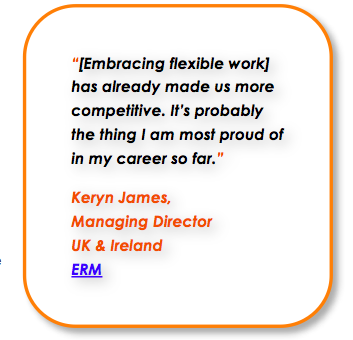
A majority of participants expect flexible work arrangements to be an important factor to remaining competitive, suggesting “significant increases in the proportion of their workforces that would be engaging in flexible work” by 2015. Some thought it would be as high as 80% of their workforce, but most predicted around 50% of their employees may take advantage of flexible work options by that time. (Compared to 25% currently.)

No doubt, significant changes will be necessary to achieve those percentages, as participants recognized that flexible work appeals to a lot of workers, but  “employees are afraid that requesting flexible work will jeopardize their career opportunities.”

Barriers to a truly flexible workplace mentioned in the study include:

  • Fear of lost control and lack of trust (on the employer’s part)
  • Losing a team spirit (if people don’t work face-to-face)
  • Legal issues
  • Measuring success and rewarding results – how to manage flexible workers without sacrificing quality

(The entire whitepaper is available at the end of this post for your review.)

If a flexible work arrangement appeals to you, here are some tips from Cali Williams Yost, author of Work+Life: Finding the Fit That’s Right for You (Riverhead, Penguin Group, 2005):

Three Fool-Proof Tips for Making Flexible Work a Success

Tip 1: Don’t expect your manager to come up with a solution. Start the conversation with him or her by presenting a clear flexibility plan that specifies the:

  • Type of flexibility you are proposing
  • How the work will get done (not “why” you want flexibility—it doesn’t matter)
  • How the business will benefit from your plan, and
  • When the plan will be reviewing (e.g. initially 90 days; annually thereafter)

(Step-by-step guide to create a win-win flexibility plan guaranteed to get a fair hearing: “Work+Life: Finding the Fit That’s Right for You” by Cali Williams Yost.)

Tip 2: Remember that it’s your job to (over) communicate with your boss, your team and your clients.

When you are out-of-sight because either you work from home or work flexible, non-traditional hours, be mindful of consistent accessibility and reliability:

  • If you aren’t immediately reachable, make it a priority to check messages regularly and respond in a timely manner.
  • Initiate a “check in” by email, IM or phone once or twice during the day with your team or your manager to see if there is anything you need to be aware of. Most likely there won’t be, but they will appreciate the extra effort.
  • Each week, put together one-page of highlights of accomplishments. In today’s economy, we should all have a record of what we’ve done…not just flex workers! It comes in handy when negotiating for a raise or promotion.

Tip 3: Be flexible with your flexibility.

Nothing causes a manager or a coworker to lose patience with your flexibility faster than a consistent unwillingness to periodically “go the extra mile.” If there’s an unexpected deadline and it’s your time to leave, offer to stay now and then. If you’re scheduled to work from home, offer to come into the office if it’s the only day a client can meet.

Taking the initiative, being conscientious and going the extra mile (from time to time), are small actions that go a long way to making your flexibility work for everyone.

ABOUT FLEXPATHS LLC

FlexPaths® is a leading global provider of web-based software solutions and advisory services that help companies create and leverage a flexible working culture. You can find them on Twitter, Facebook and LinkedIn.

ABOUT CALI WILLIAMS YOST

Cali is the CEO of the Flex+Strategy Group / Work+Life Fit, Inc., a flexibility strategy consulting firm. In addition to her book, Work+Life: Finding the Fit That’s Right for You (Riverhead/Penguin Group, 2005), Yost created the award-winning Work+Life Fit blog, and is an expert blogger for FastCompany.com. You can follow her on Twitter @caliyost.

Flexpaths & LinkedIn Present Think Tank Findings, Flexible Work: Perceptions & Realities

View more documents from FlexPaths.

Filed Under: Career Advice, Career/Life Balance Tagged With: Cali Williams Yost, Cali Yost, flexible work, Flexpaths, Flexpaths-LinkedIn Virtual Think Tanks, how to achieve work-life fit, how to get a flexible job, how to make flexible work a success, how to successfully work flexible hours, keppie careers, Miriam Salpeter

  • « Go to Previous Page
  • Page 1
  • Interim pages omitted …
  • Page 84
  • Page 85
  • Page 86
  • Page 87
  • Page 88
  • Interim pages omitted …
  • Page 174
  • Go to Next Page »

Follow Us!

  • Facebook
  • Instagram
  • LinkedIn
  • Pinterest
  • Twitter

Be an Insider: Sign Up to Receive Special Offers & Free Gift


About Keppie Careers

Are you a job seeker or business owner? You’ve come to the right place!
Click here to find out more.

Contact Us

Have a question or comment?
Click here to Contact Us.
© Copyright 2024 Keppie Careers